Fillet weld symbols: all around, field, stitch, both sides
A fillet weld symbol is a small triangle on a reference line, and almost everything else on it is a modifier: a circle for weld all around, a flag for a field weld, two numbers for a stitch pattern, a second triangle for the other side. Once you know what each modifier changes, you can read any fillet symbol on a drawing in about ten seconds. This article walks through each one with original drawings. The symbol system comes from AWS A2.4, the American Welding Society standard for welding symbols; the drawings and wording here are ours.
Start with the plain fillet symbol
The triangle always has its upright leg on the left. Where the triangle sits decides the side:
- Below the reference line: the weld goes on the side of the joint the arrow touches (the arrow side).
- Above the reference line: the weld goes on the opposite side (the other side).
- A triangle on both sides: a fillet on each side of the joint.
The size sits to the left of the triangle, such as 1/4. A length, if there is one, sits to the right. With no length shown, read the weld as running the full length of the joint unless the drawing says otherwise. The drawing sets the units, so check the title block before you read 1/4 as inches. For the full anatomy, see the welding symbols chart.
Try one question
Question 1 of the free 10-question check on CWI Part A. No signup. Then ask Tack, the AI study buddy, why the answer is right and the others are wrong.
NDE Fundamentals
Magnetic particle testing can be used on which of these materials?
Press A–D or 1–4 to choose an answer while this question is on screen.
Choose an answer to begin
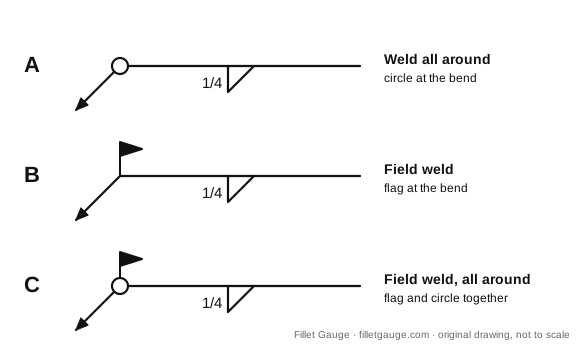
Weld all around: the circle
A circle where the arrow meets the reference line means the weld continues around the whole joint. Think of a tube welded to a plate, or a stiffener welded on every edge that touches the base. One symbol covers the whole run, even where the joint turns corners.
Two things to keep straight:
- The circle changes how far the weld goes, not its size or type. The size and the side still come from the triangle.
- It does not turn a one-sided fillet into a two-sided one. A triangle below the line with a circle means a fillet all around on the arrow side only.
Field weld: the flag
A flag at the same bend means the weld is made at the job site during erection, not in the shop. It changes where and when the work happens. It does not change the size, the type or the length.
The flag and the circle can sit together. A flag with a circle reads as a field weld, all the way around.
Use this diagram
Intermittent fillets: length-pitch (stitch welds)
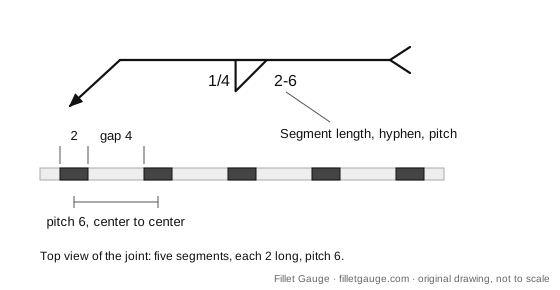
Stitch weld is shop talk. On a drawing the same idea is written as two numbers to the right of the triangle, joined by a hyphen: length-pitch.
- Length is how long each weld segment is.
- Pitch is the distance from the center of one segment to the center of the next.
- The gap between segments is the pitch minus the length.
So 2-6 means 2-long segments, 6 center to center, with a 4 gap between them. Because pitch is center to center, it is always bigger than the length. If a candidate reads 2-6 as "2 long, then 6 of empty space", they will put segments too far apart.
Use this diagram
A quick sense check: the welded share of the joint is roughly length divided by pitch. A 2-6 pattern welds about a third of the joint. A 3-12 pattern welds about a quarter. How the first and last segments sit at the ends of the joint comes from the drawing, so read the views and notes.
Chain versus staggered
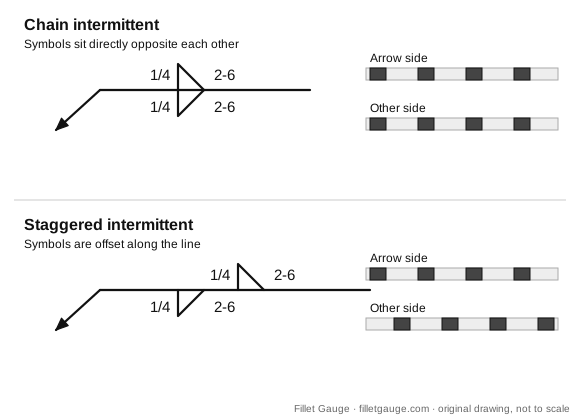
When an intermittent fillet is called for on both sides, the two symbols can line up or not.
- Chain intermittent: the symbols sit directly opposite each other on the reference line, so the segments on the two sides line up.
- Staggered intermittent: the symbol on one side is shifted along the line, so the segments on one side fall in the gaps of the other.
Both patterns use the same length-pitch numbers. Only the offset between the two symbols changes.
Use this diagram
Fillets on both sides
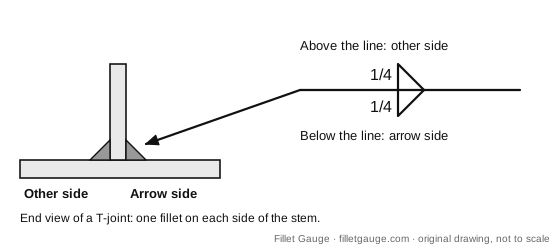
A triangle above and below the line means one fillet on each side of the same joint. If the numbers match, you have an equal fillet on each side. If they differ, such as 1/4 below and 5/16 above, each side has its own size. A number belongs to the triangle it sits beside.
Use this diagram
To turn a fillet size into a throat so you can check the numbers, use the fillet weld calculator.
Reading order that works every time
- Find the arrow and the joint it touches. Everything on this symbol is for that joint.
- Settle the side. Triangle below the line is the arrow side, above is the other side, both is both.
- Read the size to the left of each triangle.
- Read the right side: a single number is a length, a length-pitch pair is an intermittent weld.
- Check the bend: a circle means all around, a flag means field.
- Check the tail for a process or a specification.
Two worked symbols
Symbol 1. A flag and a circle at the bend, a triangle below the line marked 5/16, and GMAW in the tail. Reading: a 5/16 fillet on the arrow side, all the way around the joint, made at the job site with gas metal arc welding.
Symbol 2. A triangle below the line and another above it, shifted to the right along the line, each marked 1/4 with 3-9 on its right. Reading: a staggered intermittent 1/4 fillet on both sides of the joint. Each segment is 3 long, the pitch is 9 center to center, so the gap is 6 and each side is welded about a third of its length. The offset puts the other-side segments in the arrow-side gaps.
If either one tripped you, rebuild it in the welding symbol builder: pick the weld, side, size, length, pitch and marks, and it draws the symbol and reads it back in words. Then drill the shapes and the dimension positions in the welding symbols quiz. Position codes such as 2F are a separate topic, covered in weld joint types and positions.
Why this matters for the CWI exam
Symbols, Welding and NDE is at least 10% of CWI Part A, and Part A is closed book, so every circle, flag and length-pitch pair has to come from memory. Part B draws on the same skill when you read a drawing in the practical. The how to read welding symbols guide points you to the A2.4 clauses for fillet size, length and intermittent welds so you can look them up in your own copy of the standard.
Find out if symbols are costing you points
Take the free 10-question check. It is weighted to the Part A outline and scored by area, so you see in a few minutes whether symbols or another subject needs your study time first. The Part A course then gives you a lesson on reading welding symbols, two full-length timed practice exams and a worked explanation with every answer.
FAQ
What does the circle on a welding symbol mean?
It is the weld-all-around mark. The weld continues around the whole joint. It does not change the size or turn a one-sided weld into a two-sided one.
What does 2-6 mean on a fillet weld symbol?
Each weld segment is 2 long and the segments are 6 apart, measured from the center of one to the center of the next. That leaves a gap of 4 between segments.
What is the difference between chain and staggered intermittent welds?
In a chain pattern the segments on the two sides line up opposite each other. In a staggered pattern one side is shifted so its segments fall between the other side's segments. The length-pitch numbers work the same way in both.
What is a stitch weld symbol?
Stitch weld is a shop term for an intermittent weld. The drawing shows it as a fillet or groove symbol with length-pitch numbers to the right, such as 3-9, not with the word stitch.
Related guides
Free tools for this topic
Keep reading
Your next step
Ready to see where you stand on CWI Part A?
Free, untimed and scored by domain. No signup.
Start the free 10-question checkPart A course. Lessons, timed practice exams and a plan around your exam date. Get Part A course · $99 See the plans or read the free sample lesson.Terms and refunds
More free practice
- Read a free lesson
- Take the free 25-question timed test
- Question of the day
- Free flashcards
- Print a class quiz (free PDF)
- Print the flashcards as cut-out cards (free PDF)
The free check and the course are on the CWI Part A page.