Seam weld symbol: what it means on a drawing
The seam weld symbol is a circle crossed by two parallel lines that run along the reference line. It calls for a seam weld: one continuous weld, or a row of overlapping welds, between overlapping members, often made with rotating wheel electrodes. Centered on the line, it has no arrow side or other side.
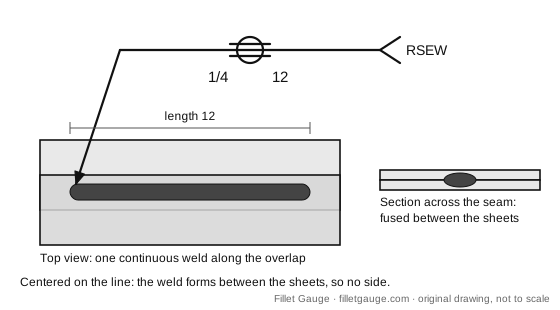
Use this diagram
How to read it
- Check the position. Centered on the line means no side significance, because the weld forms at the faying surface between the sheets. A seam made from one side, such as some arc or beam seams, can be drawn above or below the line, and then the side reads as it does for any other weld.
- Read the left side. The number is the seam's size, its width. Under A2.4:2020 the left side carries size only. If the design needs a strength, it goes in a note in the tail.
- Read the right side. A single number is the length of the seam. With none, the seam runs the full joint, or to limits the drawing marks.
- Read length and pitch. Two numbers joined by a hyphen, such as 2-5, make the seam intermittent: 2 long, with segments 5 apart center to center. It works like stitch notation on a fillet.
- Read the tail. The process goes there. RSEW is resistance seam welding, the most common way seam welds are made.
Try one question
Question 1 of the free 10-question check on CWI Part A. No signup. Then ask Tack, the AI study buddy, why the answer is right and the others are wrong.
Symbols - Welding and NDE
On a welding symbol, what does a circle at the junction of the arrow and the reference line indicate?
Press A–D or 1–4 to choose an answer while this question is on screen.
Choose an answer to begin
Where you see seam welds
Seams are used where a joint must be continuous or tight along its length, such as on fuel tanks, ducts and containers made from sheet. Resistance seam welding passes the sheets between two wheel electrodes that roll along the overlap and make one weld after another, close enough to form a continuous seam.
Ask Tack before you buy AI your Fillet Gauge study buddy
See what's on the CWI Part A exam, test yourself with 5 quick questions, or find the plan that fits you.
The CWI Part A course
Available now · instant accessLearn every Part A topic, then prove it on timed practice exams.
- 10modules of lessonsEvery task on the outline
- 2full-length timed exams165 questions in 135 minutes each
- 704practice questionsEach one explained
- 5worked calculationsStep by step
- 1week-by-week study planSet to your exam date
Turn a practice answer into a study step. In untimed practice, ask Tack AI about any question you answer, follow up, then see your weakest topics and what to drill next.
Instant access. Terms and refunds · Secure checkout by Stripe · Billed by Nori Software
- Full CWI prep$249$48 less than buying the 3 courses separatelyIncludes the CWI Part A, CWI Part B and CWI Part C D1.1 courses
Terms and refunds · Secure checkout by Stripe · Billed by Nori Software
- Free sample lessonFree
- Question of the dayFree
Every answer comes with a full explanation.
Common mix-ups
- Seam or spot. A plain circle is a spot weld: separate welds at points. Add two parallel lines through the circle and it's a seam: a weld along a line.
- Seam or weld all around. The all-around circle sits at the arrow bend, beside another weld symbol. The seam circle sits on the line in the weld symbol's place and has the two lines.
- Seam or stud. The stud mark is a circle with an X inside. The seam's lines run straight through the circle and out both sides.
- Width or strength. On a 2020-edition drawing, the left number is width. On older drawings it could be a strength per unit length. Check the edition the drawing names.
Seams on the CWI exam
Seam, spot and stud marks are all part of Symbols, Welding and NDE, at least 10% of CWI Part A, and with no book in Part A the circle-and-lines detail has to be instant. Part B drawings use them under Utilization of Specifications and Drawings, at least 8% of the practical.
Practice it
Build a centered seam in the welding symbol builder, add a length and a pitch, and read back what it calls for. See the seam beside the spot and every other shape on the welding symbols chart.
Seam or spot, every time? Check the rest of Part A
Take the free 10-question check. It's weighted to the Part A outline, scored by domain and needs no signup, so you see whether symbols or another domain costs you the most points. The Part A course gives you a lesson on reading welding and NDE symbols and on every other exam subject, two full-length timed practice exams, and a worked explanation with every answer.
Sources
Show the list
- AWS A2.4:2020, Standard Symbols for Welding, Brazing, and Nondestructive Examination, free sample, American Welding Society. Retrieved 20 Oct 2026.
- Spot, Seam, Stud Welding Symbols, Interpretation of Metal Fab Drawings, Open Oregon Educational Resources. Retrieved 21 Oct 2026.
Facts checked 24 October 2026 against the sources listed above. If something has changed, tell us and we will correct it within 2 business days.
Your next step
Ready to see where you stand on CWI Part A?
Free, untimed and scored by domain. No signup.
Start the free 10-question checkPart A course. Lessons, timed practice exams and a plan around your exam date. Get Part A course · $99 See the plans or read the free sample lesson.Terms and refunds
Want a timed run? Try the free 25-question mini-mock. The first 5 need no email.
Free tools for this topic
Prefer paper? Free printables
- Print a class quiz (free PDF). 5 practice questions with an answer key on page 2.
- Print the flashcards as cut-out cards (free PDF). The free flashcard sample, ready to cut and carry.
From the blog
- Fillet weld symbols: all around, field, stitch, both sides
- Weld joint types and positions: 1G, 2F and more
- Certified welding inspector study plan: 30, 60 or 90 days