Weld position trainer: plate and pipe

Name the position from a drawing of the joint, or pick the drawing for a code such as 3F or 5G. Each answer explains the geometry behind it.

Original drawings · 12 designations

Weld position trainer

How to use it ↓

See a drawing and choose its designation. Set 20261026 · 0 of 12 answered · 0 correct

Question 1 of 12 · Name the position

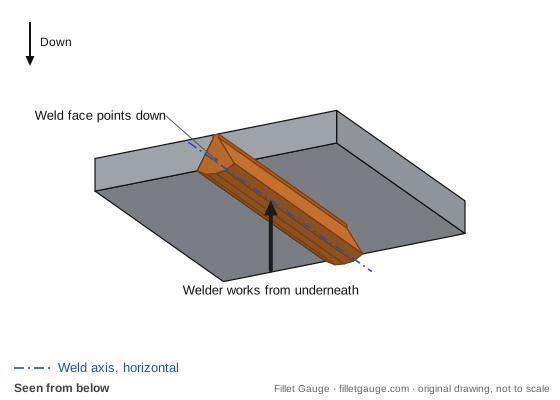
Two level plates overhead, seen from below, with a V-groove that opens downward and is filled with weld metal. The weld axis is horizontal, the weld face points down and the welder works from underneath.
Which designation does this drawing show?

Hint

The plates are level here too. Find where the welder works and which way the groove opens.

What is a weld position? It describes how the weld sits in space while you make it. A position code has two parts: the number is the position (1 flat, 2 horizontal, 3 vertical, 4 overhead) and the letter is the weld type (G for groove, F for fillet). Pipe adds 5G and 6G because the pipe can be turned or fixed.

Reading the code is the easy part. The harder call is looking at a joint and seeing the axis, which way the weld face points and whether the pipe turns. Our weld joint types and positions explainer covers the codes and the five joint types.

How to use the trainer

Each set runs all 12 designations in a shuffled order. In Name the position you see one drawing and choose from four codes. In Pick the drawing you see a code and choose from four drawings. The other three options are always the ones easiest to mix up with the answer: the same number with the other letter, the next position number, or the rolled and fixed versions of a pipe.

Every drawing shows the same cues. An arrow at the top left points down. The blue dash-dot line is the axis, named in the legend. The orange metal is the weld, and the heavy arrow shows where the welder works. Overhead drawings are seen from below and say so. After you check an answer you get the geometry of the right one and, if you missed, what your choice shows instead. Hit New shuffle for a fresh order, and quote the set number if you report an error.

The 12 designations at a glance

CodeWeld and formPosition
1G plateGroove, plateflat
2G plateGroove, platehorizontal
3G plateGroove, platevertical
4G plateGroove, plateoverhead
1F plateFillet, plateflat
2F plateFillet, platehorizontal
3F plateFillet, platevertical
4F plateFillet, plateoverhead
1G pipeGroove, pipepipe axis horizontal, rolled
2G pipeGroove, pipepipe axis vertical, fixed
5G pipeGroove, pipepipe axis horizontal, fixed
6G pipeGroove, pipepipe fixed at a 45 degree incline

Worked example: telling 5G from 6G

A drawing shows a pipe joint on a stand with a weld around it. Step 1: find the axis. If the dash-dot line runs level, the choice is between 1G and 5G. If it rises at 45 degrees from the dashed horizontal line, it is 6G. Step 2: check rotation. Rollers under the pipe and a turning arrow mean it is rolled and the welder stays on top, which is 1G. A fixed stand and an arrow running around the weld mean the welder goes around the pipe, which is 5G when the axis is level. Step 3: check the letter. A weld joining two pipes end to end is a groove weld, so the code ends in G.

Three traps the trainer is built around

  • Pipe 1G and plate 1G share a code. Both are flat groove welds. The pipe version gets there by rolling the pipe, which is why the rotation matters.
  • 2G plate and 3G plate both stand upright. What differs is the joint line: across the plates for 2G, up and down for 3G.
  • 1F does not look like a flat plate. The T-joint is turned so the two plates form a trough and the fillet face is level, which is what makes it flat.

Weld position FAQ

What do the number and letter in a weld position mean?

The number is the position and the letter is the weld type. 1 is flat, 2 is horizontal, 3 is vertical and 4 is overhead. G means a groove weld and F means a fillet weld. So 3F is a fillet weld in the vertical position and 4G is a groove weld overhead.

What is the difference between 1G and 5G pipe?

In both the pipe axis is horizontal. In 1G the pipe is rolled while the welder stays on top, so the whole weld is made flat. In 5G the pipe is fixed, so the welder works around it and the weld passes through flat, vertical and overhead.

Why is 6G the hardest common pipe position?

The pipe is fixed at an incline of 45 degrees, so the weld around it is tilted as well. One weld combines all positions, and the welder has to change technique all the way round.

Positions sit beside joints and symbols in Part A. For the whole exam, read the CWI Part A exam guide. To practice the symbol side, try the welding symbol builder.

12 original drawings: plate groove 1G to 4G, plate fillet 1F to 4F and pipe groove 1G, 2G, 5G and 6G. Name the designation from the drawing, or pick the drawing for a designation. Every answer explains the geometry: groove or fillet, plate or pipe, the axis, and whether the pipe is rolled or fixed.

Try one free question

Try one question

Question 1 of the free 10-question check on CWI Part A. No signup. Then ask Tack, the AI study buddy, why the answer is right and the others are wrong.

Question 1 of 10 · free checkUntimed

NDE Fundamentals

Magnetic particle testing can be used on which of these materials?

Press A–D or 1–4 to choose an answer while this question is on screen.

Choose an answer to begin

Email me the free CWI Part A exam-day kit

What to bring, arriving and the testing room, plus the booking steps, from the exam body's own candidate guide. Sent to your inbox.

Ask Tack before you buy AI your Fillet Gauge study buddy

See what's on the CWI Part A exam, test yourself with 5 quick questions, or find the plan that fits you.

Terms this tool uses

Sources

Preparing for CWI Part A?

You just worked 12 weld positions. Part A covers them alongside processes, symbols, NDE, metallurgy and the math, all closed book. The free 10-question check scores you by Part A domain in minutes, no signup. The CWI course then drills your weak spots with a worked explanation for every answer.

Take the free 10-question check

The CWI Part A course

Available now · instant access

The CWI Part A course

  • 10modules of lessonsEvery task on the outline
  • 2full-length timed exams165 questions in 135 minutes each
  • 704practice questionsEach one explained
  • 5worked calculationsStep by step
  • 1week-by-week study planSet to your exam date

Turn a practice answer into a study step. In untimed practice, ask Tack AI about any question you answer, follow up, then see your weakest topics and what to drill next.

Part A course$99

Terms and refunds · Secure checkout by Stripe · Billed by Nori Software

See the course

Compare plans

Every answer comes with a full explanation.

By the Fillet Gauge editorial team. Report an error with the set number and question number.

Add this trainer to your site

Copy the HTML with its attribution link. The iframe scrolls through the trainer and the guide below it; no external script is needed. The host must allow this page to be framed.