T-joint: meaning and how to check it
A T-joint is formed when the edge of one member meets the face of another at roughly a right angle, so the end view looks like the letter T. Stiffeners on a beam web and a gusset on a base plate are T-joints. Fillet welds are the usual choice, but groove welds work too.
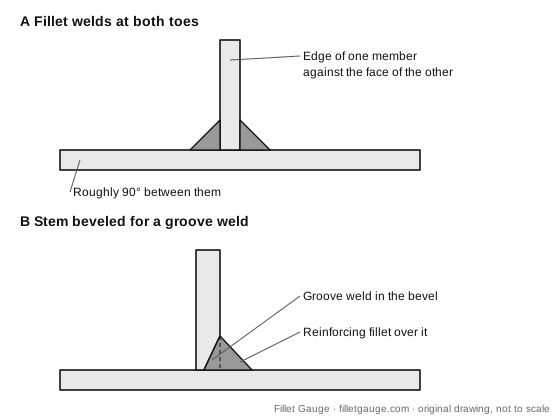
Use this diagram
How to recognise a T-joint
- Find the edge and the face. One member's edge sits against the other member's flat face, somewhere away from that face's edges. That's the core of a T.
- Check the angle. It's usually close to 90 degrees. A skewed T, where the stem leans, is still a T-joint; the angle changes how the fillet legs are sized and measured.
- Check where the stem lands. If the stem lands right at the edge of the other plate, the end view looks like an L and you have a corner joint instead.
- Read the weld. Fillets on one or both sides are the most common. A bevel or J on the stem with a reinforcing fillet over it is used when the joint has to carry more load through its full thickness.
Try one question
Question 1 of the free 10-question check on CWI Part A. No signup. Then ask Tack, the AI study buddy, why the answer is right and the others are wrong.
Definitions and Terminology
A fatigue crack in a cyclically loaded fillet-welded attachment started along the line where the surface of the weld blends into the flange plate. At which weld feature did the crack start?
Press A–D or 1–4 to choose an answer while this question is on screen.
Choose an answer to begin
Common mix-ups
- T-joint versus fillet weld. The T is the joint. The fillet is one weld you can put in it. A drawing can call a T-joint with a groove weld and no fillet at all.
- Which leg is which. On a T with a fillet, one leg runs up the stem and one runs along the base plate. Both are measured from the root, the inside corner, out to the toe. The fillet weld leg page shows how to tell an unequal-leg fillet from a sloppy equal one.
- Two sides, one joint. Fillets on both sides of the stem are two welds on one T-joint, not two joints.
Ask Tack before you buy AI your Fillet Gauge study buddy
See what's on the CWI Part A exam, test yourself with 5 quick questions, or find the plan that fits you.
The CWI Part A course
Available now · instant accessLearn every Part A topic, then prove it on timed practice exams.
- 10modules of lessonsEvery task on the outline
- 2full-length timed exams165 questions in 135 minutes each
- 704practice questionsEach one explained
- 5worked calculationsStep by step
- 1week-by-week study planSet to your exam date
Turn a practice answer into a study step. In untimed practice, ask Tack AI about any question you answer, follow up, then see your weakest topics and what to drill next.
Instant access. Terms and refunds · Secure checkout by Stripe · Billed by Nori Software
- Full CWI prep$249$48 less than buying the 3 courses separatelyIncludes the CWI Part A, CWI Part B and CWI Part C D1.1 courses
Terms and refunds · Secure checkout by Stripe · Billed by Nori Software
- Free sample lessonFree
- Question of the dayFree
Every answer comes with a full explanation.
T-joints on the CWI exam
Joint types are part of Definitions and Terminology, at least 12% of the closed-book Part A. Expect to name a joint from a drawing, and to tell the joint from the weld that fills it.
Part B's plastic replica set includes a T-joint. You measure its fillet legs, convexity and undercut with the gauges in the supplied kit, so the joint and its parts need to be second nature before you open the case. Welding Inspection and Discontinuities is at least 34% of the practical.
On a D1.1 Part C, fillet welds in T-joints show up across design (Clause 4), prequalification (Clause 5) and fabrication (Clause 7). Look the details up in your own copy; nothing from the code is quoted here.
Practice it
Run a few fillet sizes for a T-joint through the fillet weld calculator to see how leg size turns into throat and weld metal per foot. Then compare the other joint shapes in the welding terms glossary, or see how the symbol for a T-joint fillet reads on the fillet weld symbol page.
Know your joints? Check the rest of Part A
Take the free 10-question check. It's weighted to the Part A outline, scored by domain and needs no signup, so you see which domain costs you the most points. The Part A course then gives you a lesson on every exam subject, two full-length timed practice exams, and a worked explanation with every answer.
Sources
Show the list
- AWS bookstore, terminology and symbols listing, American Welding Society. Retrieved 20 Oct 2026.
- CWI Part A Fundamentals Examination Information, American Welding Society, Rev. 03.01.2024. Retrieved 20 Oct 2026.
- AWS B5.1:2025, Specification for the Qualification of Welding Inspectors, American Welding Society, Tables 5.1 and 8.1. Retrieved 20 Oct 2026.
Facts checked 25 October 2026 against the sources listed above. If something has changed, tell us and we will correct it within 2 business days.
Your next step
Ready to see where you stand on CWI Part A?
Free, untimed and scored by domain. No signup.
Start the free 10-question checkPart A course. Lessons, timed practice exams and a plan around your exam date. Get Part A course · $99 See the plans or read the free sample lesson.Terms and refunds
Want a timed run? Try the free 25-question mini-mock. The first 5 need no email.
Prefer paper? Free printables
- Print a class quiz (free PDF). 5 practice questions with an answer key on page 2.
- Print the flashcards as cut-out cards (free PDF). The free flashcard sample, ready to cut and carry.
From the blog
- CWI practice test score: am I ready for the exam?
- What Is a Certified Welding Inspector? CWI Job Description
- Weld discontinuities explained for the CWI exam