Weld pass vs weld layer: meaning and how to check it
A weld pass is one trip of the arc or flame along the joint, leaving one bead behind. A weld layer is one level of weld metal in a multipass weld, and it can be made of a single pass or several passes laid side by side. Count passes to track the welding; count layers to track the build-up.
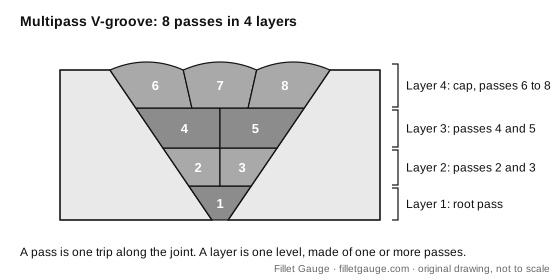
Use this diagram
How to tell passes from layers
- Count the beads. On an etched cross-section, each bead outline is one pass. In the drawing above there are eight.
- Group them by height. Beads sitting side by side at the same level form one layer. The drawing has four: the root, two fill layers and the cap.
- Name the passes by job. The root pass goes in first and forms the root. Fill passes build the joint up. Cap or cover passes finish the face. Some procedures add a hot pass right after the root to burn out trapped slag.
- Check the bead style. A stringer bead runs straight with little side-to-side motion. A weave bead swings across the joint, so one weave pass can fill a layer that would take two or three stringers.
Try one question
Question 1 of the free 10-question check on CWI Part A. No signup. Then ask Tack, the AI study buddy, why the answer is right and the others are wrong.
Definitions and Terminology
A fatigue crack in a cyclically loaded fillet-welded attachment started along the line where the surface of the weld blends into the flange plate. At which weld feature did the crack start?
Press A–D or 1–4 to choose an answer while this question is on screen.
Choose an answer to begin
Common mix-ups
- Pass versus bead. The pass is the act of welding along the joint once; the bead is the metal it leaves. In practice the words are used together, but the pass is the action.
- Layer versus pass in a WPS. A procedure may control whether a layer is made with one pass or several, or cap the width of a weave. Read what the WPS says rather than assuming one pass per layer.
- Root pass versus root. The root pass forms the weld root, but the root is a location and the pass is a bead.
- Interpass work. Between passes come cleaning and a temperature check. That's what interpass temperature is about.
- Reheating. Each new pass reheats the beads and the heat-affected zone below it, so pass order changes the metallurgy, not just the shape.
Ask Tack before you buy AI your Fillet Gauge study buddy
See what's on the CWI Part A exam, test yourself with 5 quick questions, or find the plan that fits you.
The CWI Part A course
Available now · instant accessLearn every Part A topic, then prove it on timed practice exams.
- 10modules of lessonsEvery task on the outline
- 2full-length timed exams165 questions in 135 minutes each
- 704practice questionsEach one explained
- 5worked calculationsStep by step
- 1week-by-week study planSet to your exam date
Turn a practice answer into a study step. In untimed practice, ask Tack AI about any question you answer, follow up, then see your weakest topics and what to drill next.
Instant access. Terms and refunds · Secure checkout by Stripe · Billed by Nori Software
- Full CWI prep$249$48 less than buying the 3 courses separatelyIncludes the CWI Part A, CWI Part B and CWI Part C D1.1 courses
Terms and refunds · Secure checkout by Stripe · Billed by Nori Software
- Free sample lessonFree
- Question of the dayFree
Every answer comes with a full explanation.
Passes and layers on the CWI exam
Pass, layer, bead, stringer and weave are terms in Definitions and Terminology, at least 12% of Part A, and the control of them sits in Welding Application and Control, at least 9% of Part A. Part A is closed book.
On Part B, procedure documents set limits on passes and bead style. Procedure and Performance Qualifications is at least 28% of the practical, and checking a record of passes against a WPS is the kind of task that domain covers.
On a D1.1 Part C, single-pass and multipass limits appear in the prequalification rules in Clause 5 and the workmanship rules in Clause 7. Look them up in your own copy.
Practice it
The discontinuity cards in the CWI Part A flashcards tie slag inclusions to cleaning between passes and to a weave that runs too wide. Every term from this page sits in the welding terms glossary.
Know your passes? Check the rest of Part A
Take the free 10-question check. It's weighted to the Part A outline, scored by domain and needs no signup, so you see which domain costs you the most points. The Part A course then gives you a lesson on every exam subject, two full-length timed practice exams, and a worked explanation with every answer.
Sources
Show the list
- AWS bookstore, terminology and symbols listing, American Welding Society. Retrieved 20 Oct 2026.
- CWI Part A Fundamentals Examination Information, American Welding Society, Rev. 03.01.2024. Retrieved 20 Oct 2026.
- AWS B5.1:2025, Specification for the Qualification of Welding Inspectors, American Welding Society, Tables 5.1 and 8.1. Retrieved 20 Oct 2026.
Facts checked 25 October 2026 against the sources listed above. If something has changed, tell us and we will correct it within 2 business days.
Your next step
Ready to see where you stand on CWI Part A?
Free, untimed and scored by domain. No signup.
Start the free 10-question checkPart A course. Lessons, timed practice exams and a plan around your exam date. Get Part A course · $99 See the plans or read the free sample lesson.Terms and refunds
Want a timed run? Try the free 25-question mini-mock. The first 5 need no email.
Prefer paper? Free printables
- Print a class quiz (free PDF). 5 practice questions with an answer key on page 2.
- Print the flashcards as cut-out cards (free PDF). The free flashcard sample, ready to cut and carry.
From the blog
- Preheat, heat input and cracking for the CWI
- How hard is the CWI exam? What each part asks of you
- Weld discontinuities explained for the CWI exam