Edge joint: meaning and how to check it
An edge joint is two or more members laid face to face, parallel or nearly parallel, with their edges lined up and welded together along those edges. It's mostly a thin-material joint: flanged sheet, the rims of tanks and covers, and parts that won't carry much load across the weld. The weld joins edges, not faces.
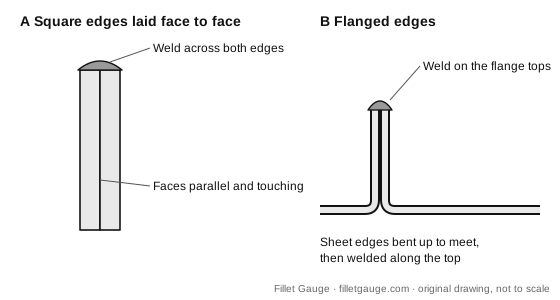
Use this diagram
How to recognise an edge joint
- Faces together, edges flush. The members touch (or nearly touch) face to face, and their edges sit side by side. Picture two sheets in a stack with the weld along one end of the stack.
- Find the weld on the edges. The bead covers the ends of both members at once. There's no inside corner for a fillet.
- Look for flanges. On sheet, the edges are often bent up so two flanges stand face to face. That's still an edge joint, and the weld goes along the top of the flanges.
Try one question
Question 1 of the free 10-question check on CWI Part A. No signup. Then ask Tack, the AI study buddy, why the answer is right and the others are wrong.
Definitions and Terminology
A fatigue crack in a cyclically loaded fillet-welded attachment started along the line where the surface of the weld blends into the flange plate. At which weld feature did the crack start?
Press A–D or 1–4 to choose an answer while this question is on screen.
Choose an answer to begin
Common mix-ups
- Edge joint versus edge weld. The edge joint is the joint type. An edge weld is a weld type, with its own symbol, that's typically used on it. Read the edge weld symbol page for the symbol side.
- Edge versus corner. A corner joint has the members at an angle, meeting at their edges like an L. An edge joint has them parallel.
- Edge versus lap. In a lap joint the members overlap and the welds sit at the edge of one plate against the face of the other. In an edge joint the edges are flush and the weld covers both edges together.
- Edge versus butt. In a butt joint the members are side by side in one plane, edge against edge. In an edge joint they're stacked, face against face.
Ask Tack before you buy AI your Fillet Gauge study buddy
See what's on the CWI Part A exam, test yourself with 5 quick questions, or find the plan that fits you.
The CWI Part A course
Available now · instant accessLearn every Part A topic, then prove it on timed practice exams.
- 10modules of lessonsEvery task on the outline
- 2full-length timed exams165 questions in 135 minutes each
- 704practice questionsEach one explained
- 5worked calculationsStep by step
- 1week-by-week study planSet to your exam date
Turn a practice answer into a study step. In untimed practice, ask Tack AI about any question you answer, follow up, then see your weakest topics and what to drill next.
Instant access. Terms and refunds · Secure checkout by Stripe · Billed by Nori Software
- Full CWI prep$249$48 less than buying the 3 courses separatelyIncludes the CWI Part A, CWI Part B and CWI Part C D1.1 courses
Terms and refunds · Secure checkout by Stripe · Billed by Nori Software
- Free sample lessonFree
- Question of the dayFree
Every answer comes with a full explanation.
Edge joints on the CWI exam
Joint types are in Definitions and Terminology, at least 12% of the closed-book Part A. The edge joint is the one candidates name least often, which makes it a common trap when it's drawn next to a corner or a lap.
The edge weld symbol also sits under Symbols, Welding and NDE, at least 10% of Part A, so expect the joint and the symbol to be tested together.
Structural codes such as D1.1 rarely use edge joints for load-carrying welds, so they're a smaller target on Part C. Check your own copy if a Part C reference asks about one.
Practice it
The CWI Part A flashcards cover the symbol, metallurgy and discontinuity terms that sit around the joint names. The welding terms glossary has all five side by side with the weld terms that go with them.
Know your joints? Check the rest of Part A
Take the free 10-question check. It's weighted to the Part A outline, scored by domain and needs no signup, so you see which domain costs you the most points. The Part A course then gives you a lesson on every exam subject, two full-length timed practice exams, and a worked explanation with every answer.
Sources
Show the list
- AWS bookstore, terminology and symbols listing, American Welding Society. Retrieved 20 Oct 2026.
- CWI Part A Fundamentals Examination Information, American Welding Society, Rev. 03.01.2024. Retrieved 20 Oct 2026.
- AWS B5.1:2025, Specification for the Qualification of Welding Inspectors, American Welding Society, Tables 5.1 and 8.1. Retrieved 20 Oct 2026.
Facts checked 25 October 2026 against the sources listed above. If something has changed, tell us and we will correct it within 2 business days.
Your next step
Ready to see where you stand on CWI Part A?
Free, untimed and scored by domain. No signup.
Start the free 10-question checkPart A course. Lessons, timed practice exams and a plan around your exam date. Get Part A course · $99 See the plans or read the free sample lesson.Terms and refunds
Want a timed run? Try the free 25-question mini-mock. The first 5 need no email.
Prefer paper? Free printables
- Print a class quiz (free PDF). 5 practice questions with an answer key on page 2.
- Print the flashcards as cut-out cards (free PDF). The free flashcard sample, ready to cut and carry.
From the blog
- CWI Part A practice questions: how to drill them
- Failed a CWI part? Rebuild your study plan
- What Is a Certified Welding Inspector? CWI Job Description