Bevel angle vs groove angle: meaning and how to check it
The bevel angle is the angle cut on one member's edge, measured from a line square to that member's surface. The groove angle is the total angle of the opening between the two members. On a single-bevel joint the two are equal. On a symmetric single-V, the groove angle is twice the bevel angle.
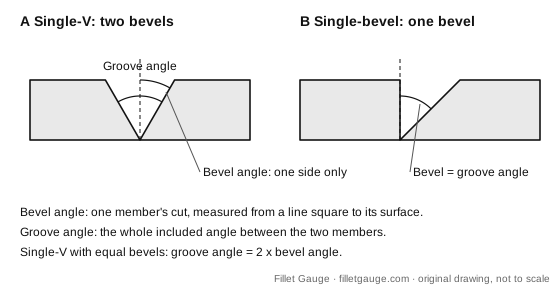
Use this diagram
How to measure each angle
- Ask what's being measured. One member's edge? That's a bevel angle. The space between both members? That's the groove angle.
- Find the reference line. A bevel angle is measured from a line at right angles to the plate surface, not from the plate surface itself. Measuring from the surface gives you the complement and a wrong reading.
- Add up the sides. A single-V with two equal bevels has a groove angle of twice either bevel. A single-V with unequal bevels has a groove angle equal to the sum of the two.
- Check with a protractor or bevel gauge. Set one arm on the plate surface or square to it, read the bevel, and repeat on the other member if it's beveled too.
- Read the symbol. On a groove weld symbol, the angle written outside the open end of the groove mark is the groove angle.
Try one question
Question 1 of the free 10-question check on CWI Part A. No signup. Then ask Tack, the AI study buddy, why the answer is right and the others are wrong.
Definitions and Terminology
A fatigue crack in a cyclically loaded fillet-welded attachment started along the line where the surface of the weld blends into the flange plate. At which weld feature did the crack start?
Press A–D or 1–4 to choose an answer while this question is on screen.
Choose an answer to begin
Common mix-ups
- Single-bevel versus single-V. On a single-bevel joint only one member is cut, so groove angle and bevel angle are the same number. On a V, they aren't.
- Bevel angle versus bevel. "Bevel" also names the cut edge itself and the joint type. The angle is just one dimension of it.
- The symbol shows groove angle. Candidates often read the number on a V-groove symbol as the bevel. It's the included angle of the whole groove.
- J and U preps. These use a bevel radius as well as an angle, and the radius usually comes from a joint detail rather than the symbol.
- Below the bevel. The flat strip under the bevel is the root face, and the gap between members is the root opening. Neither is an angle.
Ask Tack before you buy AI your Fillet Gauge study buddy
See what's on the CWI Part A exam, test yourself with 5 quick questions, or find the plan that fits you.
The CWI Part A course
Available now · instant accessLearn every Part A topic, then prove it on timed practice exams.
- 10modules of lessonsEvery task on the outline
- 2full-length timed exams165 questions in 135 minutes each
- 704practice questionsEach one explained
- 5worked calculationsStep by step
- 1week-by-week study planSet to your exam date
Turn a practice answer into a study step. In untimed practice, ask Tack AI about any question you answer, follow up, then see your weakest topics and what to drill next.
Instant access. Terms and refunds · Secure checkout by Stripe · Billed by Nori Software
- Full CWI prep$249$48 less than buying the 3 courses separatelyIncludes the CWI Part A, CWI Part B and CWI Part C D1.1 courses
Terms and refunds · Secure checkout by Stripe · Billed by Nori Software
- Free sample lessonFree
- Question of the dayFree
Every answer comes with a full explanation.
Bevel and groove angles on the CWI exam
Both terms are in Definitions and Terminology, at least 12% of the closed-book Part A, and the groove angle on a symbol is part of Symbols, Welding and NDE, at least 10% of Part A.
The Part B tool kit includes a protractor, and reading angles off joint details is part of Utilization of Specifications and Drawings, at least 8% of the practical.
On a D1.1 Part C, groove angles appear in the prequalified joint details in Clause 5 and in fit-up in Clause 7. Read the dimensions and tolerances in your own copy; none are given here.
Practice it
The weld gauge reading trainer builds the gauge habits angle checks rely on: zero the tool, set it square, read the nearest mark. See the groove angle on a symbol in the V-groove weld symbol page, and the rest of the joint-prep terms in the welding terms glossary.
Read fit-up cold? Check the rest of Part A
Take the free 10-question check. It's weighted to the Part A outline, scored by domain and needs no signup, so you see which domain costs you the most points. The Part A course then gives you a lesson on every exam subject, two full-length timed practice exams, and a worked explanation with every answer.
Sources
Show the list
- AWS bookstore, terminology and symbols listing, American Welding Society. Retrieved 20 Oct 2026.
- CWI Part A Fundamentals Examination Information, American Welding Society, Rev. 03.01.2024. Retrieved 20 Oct 2026.
- AWS B5.1:2025, Specification for the Qualification of Welding Inspectors, American Welding Society, Tables 5.1 and 8.1. Retrieved 20 Oct 2026.
Facts checked 25 October 2026 against the sources listed above. If something has changed, tell us and we will correct it within 2 business days.
Your next step
Ready to see where you stand on CWI Part A?
Free, untimed and scored by domain. No signup.
Start the free 10-question checkPart A course. Lessons, timed practice exams and a plan around your exam date. Get Part A course · $99 See the plans or read the free sample lesson.Terms and refunds
Want a timed run? Try the free 25-question mini-mock. The first 5 need no email.
Prefer paper? Free printables
- Print a class quiz (free PDF). 5 practice questions with an answer key on page 2.
- Print the flashcards as cut-out cards (free PDF). The free flashcard sample, ready to cut and carry.
From the blog
- CWI study plan for people who work full time
- Welding processes for the CWI exam: SMAW to SAW
- Is CWI certification worth it? A cost-versus-value check