Root face: meaning and how to check it
A root face, also called a land, is the short flat strip left on the edge of a member at the bottom of a bevel or J preparation. Rather than grinding to a knife edge, the fitter leaves a small square edge. It gives the root pass something to fuse into without burning straight through.
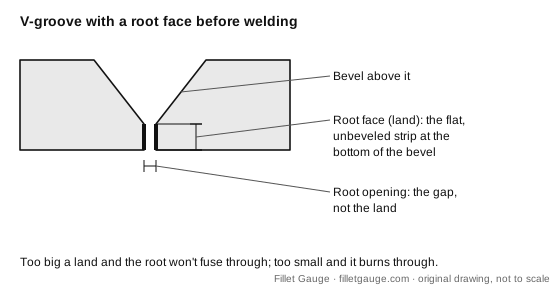
Use this diagram
How to recognise and check a root face
- Look at the edge, not the gap. The root face is on the member. Run your eye down the bevel: where the slope stops and the edge turns square, that square strip is the land.
- Measure its height. Measure the flat strip from the bottom of the bevel to the bottom surface of the plate. A small rule, a fit-up gauge or a caliper works.
- Check along the joint. Hand-ground bevels vary. A land that's thick in one spot and thin in another will weld unevenly.
- Compare with the WPS. The joint detail or WPS sets the root face. Use the documents, not your eye, to decide whether it's right.
Try one question
Question 1 of the free 10-question check on CWI Part A. No signup. Then ask Tack, the AI study buddy, why the answer is right and the others are wrong.
Definitions and Terminology
A fatigue crack in a cyclically loaded fillet-welded attachment started along the line where the surface of the weld blends into the flange plate. At which weld feature did the crack start?
Press A–D or 1–4 to choose an answer while this question is on screen.
Choose an answer to begin
Common mix-ups
- Root face versus root opening. The face is a dimension of the edge. The opening is the gap between two edges. A joint can have a land and no gap, or a gap and no land.
- Too much land. A thick root face holds back fusion, and the root may not penetrate through. That shows up as incomplete penetration on the far side.
- Too little land. A knife edge melts away fast, which invites burn-through or a sagging root, especially with a wide opening.
- Land versus backing. A root face is part of the plate. Backing is a separate strip placed under the joint. Some joints use both.
- The bevel above it. The land is measured below the bevel. The bevel itself has its own angle, covered on the bevel angle vs groove angle page.
Ask Tack before you buy AI your Fillet Gauge study buddy
See what's on the CWI Part A exam, test yourself with 5 quick questions, or find the plan that fits you.
The CWI Part A course
Available now · instant accessLearn every Part A topic, then prove it on timed practice exams.
- 10modules of lessonsEvery task on the outline
- 2full-length timed exams165 questions in 135 minutes each
- 704practice questionsEach one explained
- 5worked calculationsStep by step
- 1week-by-week study planSet to your exam date
Turn a practice answer into a study step. In untimed practice, ask Tack AI about any question you answer, follow up, then see your weakest topics and what to drill next.
Instant access. Terms and refunds · Secure checkout by Stripe · Billed by Nori Software
- Full CWI prep$249$48 less than buying the 3 courses separatelyIncludes the CWI Part A, CWI Part B and CWI Part C D1.1 courses
Terms and refunds · Secure checkout by Stripe · Billed by Nori Software
- Free sample lessonFree
- Question of the dayFree
Every answer comes with a full explanation.
Root face on the CWI exam
Root face and land are in Definitions and Terminology, at least 12% of Part A, which is closed book. The groove weld symbol doesn't show the land directly; it comes from a joint detail or the WPS, which makes it a common trap.
On Part B, joint details live in the procedure documents you're handed. Procedure and Performance Qualifications is at least 28% of the practical, and reading a WPS joint detail, land included, is the kind of check that domain is built on.
On a D1.1 Part C, root faces appear in the prequalified joint details in Clause 5. Use your own copy for the dimensions.
Practice it
The CWI Part A flashcards have a card on where the root opening and groove angle go on a groove symbol. The land is the dimension that card leaves to the joint detail. The welding terms glossary has every joint-prep term in one table.
Read fit-up cold? Check the rest of Part A
Take the free 10-question check. It's weighted to the Part A outline, scored by domain and needs no signup, so you see which domain costs you the most points. The Part A course then gives you a lesson on every exam subject, two full-length timed practice exams, and a worked explanation with every answer.
Sources
Show the list
- AWS bookstore, terminology and symbols listing, American Welding Society. Retrieved 20 Oct 2026.
- CWI Part A Fundamentals Examination Information, American Welding Society, Rev. 03.01.2024. Retrieved 20 Oct 2026.
- AWS B5.1:2025, Specification for the Qualification of Welding Inspectors, American Welding Society, Tables 5.1 and 8.1. Retrieved 20 Oct 2026.
Facts checked 25 October 2026 against the sources listed above. If something has changed, tell us and we will correct it within 2 business days.
Your next step
Ready to see where you stand on CWI Part A?
Free, untimed and scored by domain. No signup.
Start the free 10-question checkPart A course. Lessons, timed practice exams and a plan around your exam date. Get Part A course · $99 See the plans or read the free sample lesson.Terms and refunds
Want a timed run? Try the free 25-question mini-mock. The first 5 need no email.
Prefer paper? Free printables
- Print a class quiz (free PDF). 5 practice questions with an answer key on page 2.
- Print the flashcards as cut-out cards (free PDF). The free flashcard sample, ready to cut and carry.
From the blog
- Is CWI certification worth it? A cost-versus-value check
- CWI Part A practice questions: how to drill them
- Preheat, heat input and cracking for the CWI