CJP vs PJP: meaning and how to check it
A CJP (complete joint penetration) groove weld fuses weld metal through the whole thickness of the joint. A PJP (partial joint penetration) groove weld is designed to stop part way, leaving some of the joint unwelded on purpose. Neither is better in general: the right one is the one the drawing or WPS calls for.
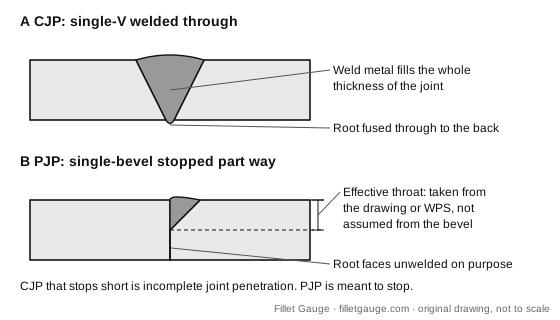
Use this diagram
How to tell CJP from PJP
- Read the tail. A note such as CJP in the tail of the welding symbol settles it. If the tail is blank, keep reading the symbol before you decide.
- Read the left side of the groove symbol. A PJP weld shows its weld size there in parentheses, usually after the groove depth: 3/4 (5/8) means the edge is prepared 3/4 deep and the weld size is 5/8. With nothing on the left of a single-sided groove symbol, read it as complete penetration unless the tail or a note says otherwise.
- Look at the prep. A joint meant to be welded through is set up so the arc can reach the far side: a modest root face, a root opening, a backing strip, or a plan to weld from both sides. A bevel that stops well short of the far side, over a thick land, is the usual look of a PJP joint.
- Check the back. On a single-sided CJP weld with no backing, the back should show a fused root bead. On a single-sided PJP weld, the joint line may still be visible from the back, and that's what the design asked for.
- Ask about the second side. On a double-sided CJP joint, the second side is often gouged back to sound metal before it's welded, so the two welds meet in clean metal. On a double-sided PJP joint, the two welds aren't meant to meet, and an unwelded band in the middle is by design.
Try one question
Question 1 of the free 10-question check on CWI Part A. No signup. Then ask Tack, the AI study assistant, why the answer is right and the others are wrong.
Definitions and Terminology
A fatigue crack in a cyclically loaded fillet-welded attachment started along the line where the surface of the weld blends into the flange plate. At which weld feature did the crack start?
Press A-D or 1-4 to choose an answer while this question is on screen.
Choose an answer to begin
Why the effective throat differs
A CJP weld carries load through the full joint thickness, because the weld reaches all the way through. A PJP weld only carries load through the depth it was designed to reach. That depth is its effective throat, and it's set by the joint detail and the welding process. It isn't assumed to equal the depth of the bevel, so read it from the drawing or WPS.
On structural steel, D1.1 deals with the effective areas of groove welds in Clause 4 and with prequalified CJP and PJP joint details in Clause 5. Look up the rules and the numbers in your own copy; none are given here.
Common mix-ups
- PJP versus incomplete joint penetration. A PJP weld stops short by design. When a weld called out as CJP stops short, that's incomplete joint penetration, a discontinuity. Read the symbol before you call it.
- Groove depth versus weld size. On a PJP symbol, the number outside the parentheses is how deep the edge is prepared and the number inside is the weld size. They're different numbers on purpose.
- Penetration versus fusion. CJP is about depth through the joint. Fusion is about the weld bonding to each surface it touches. A weld can reach the far side and still have incomplete fusion on a groove face.
- Which is better. Neither, in general. A CJP weld usually needs more joint prep and more weld metal. A PJP weld saves both where the design doesn't need the full thickness. The designer picks, and the inspector checks that what was built matches what was called for.
- Groove weld versus fillet weld. CJP and PJP describe groove welds. A fillet weld is sized by its legs, not by penetration. See fillet weld vs groove weld.
CJP and PJP on the CWI exam
AWS lists joint design among the subjects the Part A Fundamentals exam tests. Definitions and Terminology is at least 12% of the closed-book Part A, and Symbols, Welding and NDE at least 10%, which covers reading CJP in a tail and a PJP size in parentheses.
On the practical, the first question about a short root is what the drawing called for. Utilization of Specifications and Drawings is at least 8% of Part B, and Welding Inspection and Discontinuities at least 34%.
On a D1.1 Part C, effective areas are a Clause 4 subject and prequalified groove joint details a Clause 5 subject. Read both in your own copy.
Ask Tack: Am I ready?
Ask Tack before you buy AI your AI study assistant
See what's on the CWI Part A exam, test yourself with 5 quick questions, or find the plan that fits you.
The CWI Part A course
Available now · instant accessLearn every Part A topic, then prove it on timed practice exams.
Instant access. Terms and refunds · Secure checkout by Stripe · Billed by Nori Software
What's inside
- 10modules of lessonsEvery task on the outline
- 2full-length timed exams165 questions in 135 minutes each
- 720practice questionsEach one explained
- 5worked calculationsStep by step
- 1week-by-week study planSet to your exam date
Turn a practice answer into a study step. In untimed practice, ask Tack AI about any question you answer, follow up, then see your weakest topics and what to drill next.
- Full CWI prep$249$48 less than buying the 3 courses separatelyIncludes the CWI Part A, CWI Part B and CWI Part C D1.1 courses
Terms and refunds · Secure checkout by Stripe · Billed by Nori Software
- Question of the dayFree
Every answer comes with a full explanation.
Practice it
Pick a V-groove or bevel-groove weld in the welding symbol builder, set a size and a side, and read back what the symbol calls for. The fit-up terms behind both welds, root face and root opening included, are in the welding terms glossary.
Read groove symbols cold? Check the rest of Part A
Take the free 10-question check. It's weighted to the Part A outline, scored by domain and needs no signup, so you see which domain costs you the most points. The Part A course then gives you a lesson on every exam subject, two full-length timed practice exams, and a worked explanation with every answer.
Sources
Show the list
- AWS bookstore, terminology and symbols listing, American Welding Society. Checked 18 Nov 2026.
- CWI Part A Fundamentals Examination Information, American Welding Society, Rev. 03.01.2024. Checked 18 Nov 2026.
- AWS B5.1:2025, Specification for the Qualification of Welding Inspectors, American Welding Society, Tables 5.1 and 8.1. Checked 18 Nov 2026.
Fillet Gauge editorial team
Facts come from the sources listed above. If something has changed, tell us and we will correct it.
Your next step
Ready to see where you stand on CWI Part A?
Free, untimed and scored by domain. No signup.
Free 10-question checkPart A course. Lessons, timed practice exams and a plan around your exam date.
Get Part A course · $99Want a timed run? Take the free 25-question practice test (about 20 minutes). No email needed.
Prefer paper? Free printables
- Print a class quiz (free PDF). 5 practice questions with an answer key on page 2.
- Print the flashcards as cut-out cards (free PDF). The free flashcard sample, ready to cut and carry.
From the blog
- CWI Part A practice questions: how to drill them
- What Is a Certified Welding Inspector? CWI Job Description
- CWI study plan for people who work full time