Incomplete fusion: what it is and how to spot it
Incomplete fusion is weld metal that lies against the base metal, or against an earlier pass, without melting into it. The result is a thin, flat unbonded boundary inside the weld. It can sit on a groove face (sidewall), between passes (interpass), or at the toe, and it behaves much like a crack under load.
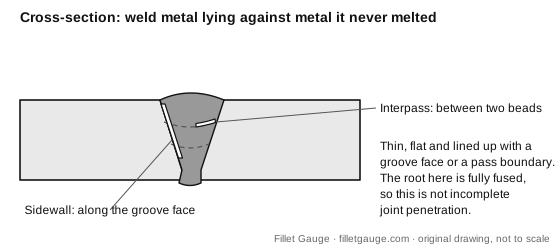
Use this diagram
How to recognize incomplete fusion
- Look for a line, not a pocket. Incomplete fusion is thin and even. It follows a surface that should have melted: the bevel face, the top of an earlier bead, or the plate at the toe.
- Name where it sits. Along the bevel is sidewall fusion. Between two beads is interpass fusion. At the edge of the cap, weld metal can roll onto the plate without bonding, which shades into overlap.
- Check the root. If the root is fully melted through, the flaw higher up is incomplete fusion, not incomplete joint penetration. That check sorts most mix-ups.
- On a macro etch, the weld metal and plate meet at a sharp, unmixed line instead of a blended fusion zone.
Try one question
Question 1 of the free 10-question check on CWI Part B. No signup. Then ask Tack, the AI study buddy, why the answer is right and the others are wrong.
Welding Inspection and Discontinuities
A convex fillet weld replica is checked with a leaf-type fillet gauge. The drawing calls for a single fillet size. The vertical leg fits the 3/8 in blade and the horizontal leg the 5/16 in blade. What size is recorded?
Press A–D or 1–4 to choose an answer while this question is on screen.
Choose an answer to begin
How it is found
Because it is planar and usually buried, visual inspection only catches incomplete fusion where it reaches the surface, such as at a cap toe or on the face of an intermediate pass that the inspector looks at before the next one goes on. Ultrasonic testing with an angle beam is well suited to it, because the sound hits the flat face square on when the angle matches the bevel. Radiography can miss it unless the beam lines up with the plane of the flaw. During welding, an inspector looks for beads that sit on the sidewall with a sharp re-entrant edge instead of wetting into it.
Ask Tack before you buy AI your Fillet Gauge study buddy
See what's on the CWI Part B exam, test yourself with 5 quick questions, or find the plan that fits you.
The CWI Part B course
Available now · instant accessLearn the tool kit, the specification and the qualification records, then practice.
- 7modules of lessonsEvery task on the outline
- 3full-length timed exams46 questions in 120 minutes each
- 338practice questionsEach one explained
- 2worked calculationsStep by step
- 21specification drillsFind it fast in the Book of Specifications
- 1week-by-week study planSet to your exam date
Turn a practice answer into a study step. In untimed practice, ask Tack AI about any question you answer, follow up, then see your weakest topics and what to drill next.
Instant access. Terms and refunds · Secure checkout by Stripe · Billed by Nori Software
- Parts B + C bundle$169$29 less than buying both courses separatelyIncludes the CWI Part B and CWI Part C D1.1 courses
Terms and refunds · Secure checkout by Stripe · Billed by Nori Software
- Full CWI prep$249$48 less than buying the 3 courses separatelyIncludes the CWI Part A, CWI Part B and CWI Part C D1.1 courses
Terms and refunds · Secure checkout by Stripe · Billed by Nori Software
- Free sample lessonFree
- Question of the dayFree
Every answer comes with a full explanation.
Common mix-ups
- Incomplete fusion or incomplete joint penetration. Fusion is about bonding to a surface. Penetration is about reaching the depth the joint needs. A fully melted root rules out incomplete penetration.
- Incomplete fusion or slag. Slag is a chunky pocket of solid. Incomplete fusion is a clean, thin line. The two often appear together, because slag left on a sidewall stops the next pass from fusing.
- Incomplete fusion or a crack. Both are planar. A crack has jagged walls and pointed tips; incomplete fusion has the smooth shape of the surface it failed to melt.
Why it forms
The arc doesn't put enough heat where it is needed: current too low, travel too fast, or an electrode angle that aims the arc at the middle of the groove instead of the sidewall. A narrow groove, mill scale or slag on the surface, a large pool rolling ahead of the arc, and arc blow all make it worse. GMAW in short-circuit transfer on thick sections is a well-known risk.
Incomplete fusion on the CWI exam
On Part B, incomplete fusion sits in Welding Inspection and Discontinuities, at least 34% of the practical, and in NDE Application when you pick the method that finds it. On Part A, it fits Visual Examination, NDE Fundamentals and Welding Application and Control. On Part C, find how the code treats fusion in its visual and NDT acceptance criteria, D1.1 Clause 8 for the D1.1 endorsement.
Practice it
Spot sidewall fusion against its look-alikes in the weld discontinuities quiz. Then read the root-side partner, incomplete joint penetration, and the flaw that often causes it, slag inclusion. The weld discontinuities guide lists every type.
Check the rest of Part B
Take the free 10-question check. It's weighted to the Part B outline, scored by domain and needs no signup, so you know which Part B domain to work on first.
Sources
Show the list
- Weld Defects / Imperfections: Lack of Sidewall and Inter-Run Fusion (Job Knowledge 41), TWI. Retrieved 25 Oct 2026.
- CWI Part B Practical Examination Information, American Welding Society, Rev. 03.01.2024. Retrieved 20 Oct 2026.
- Discontinuity names follow AWS A3.0, Standard Welding Terms and Definitions. Every description here is our own wording.
Facts checked 25 October 2026 against the sources listed above. If something has changed, tell us and we will correct it within 2 business days.
Your next step
Ready to see where you stand on CWI Part B?
Free, untimed and scored by domain. No signup.
Start the free 10-question checkPart B course. Lessons, timed practice exams and a plan around your exam date. Get Part B course · $99 See the plans or read the free sample lesson.Terms and refunds
Want a timed run? Try the free 25-question mini-mock. The first 5 need no email.
Prefer paper? Free printables
- Print a class quiz (free PDF). 5 practice questions with an answer key on page 2.
- Print the flashcards as cut-out cards (free PDF). The free flashcard sample, ready to cut and carry.
From the blog
- Visual weld inspection: before, during and after
- CWI Part B practice questions: drill measurements
- CWI vs CAWI vs SCWI: the three AWS inspector levels