Longitudinal weld crack: what it is and how to spot it
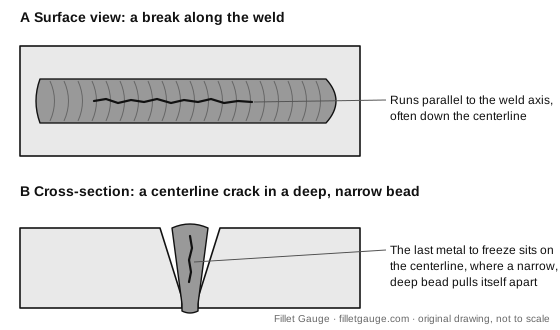
A longitudinal crack is a crack that runs parallel to the length of the weld. It most often follows the centerline of the weld metal, but it can also run along the toe or inside the heat-affected zone. Like every crack, it is a sharp-tipped separation that can keep growing under load, which is why inspectors treat it so seriously.
Use this diagram
How to recognize a longitudinal crack
- Check the direction. It runs along the weld axis. A crack across the weld is transverse; short cracks radiating in a crater are crater cracks.
- Look for a tight, jagged line. A crack wanders slightly and has pointed ends. It doesn't have the rounded walls of a pore or the open hollow of undercut.
- Note where it sits. Down the middle of the bead points to the last metal to freeze. Along the toe is a toe crack. In the plate beside the weld is likely a heat-affected zone crack.
- Use light and magnification. Side lighting and a magnifier make fine cracks visible. Many are too tight to see in flat, front-on light.
Try one question
Question 1 of the free 10-question check on CWI Part B. No signup. Then ask Tack, the AI study buddy, why the answer is right and the others are wrong.
Welding Inspection and Discontinuities
A convex fillet weld replica is checked with a leaf-type fillet gauge. The drawing calls for a single fillet size. The vertical leg fits the 3/8 in blade and the horizontal leg the 5/16 in blade. What size is recorded?
Press A–D or 1–4 to choose an answer while this question is on screen.
Choose an answer to begin
How it is found and recorded
Visual inspection finds surface cracks when they are open enough. Penetrant testing confirms fine surface cracks on any non-porous metal, and magnetic particle testing finds surface and near-surface cracks in ferromagnetic steel. Buried centerline cracks call for ultrasonic or radiographic testing. Record the crack's location, direction and length. Most documents treat cracks as a category of their own rather than giving them a size allowance, so read the governing document's crack criteria first.
Ask Tack before you buy AI your Fillet Gauge study buddy
See what's on the CWI Part B exam, test yourself with 5 quick questions, or find the plan that fits you.
The CWI Part B course
Available now · instant accessLearn the tool kit, the specification and the qualification records, then practice.
- 7modules of lessonsEvery task on the outline
- 3full-length timed exams46 questions in 120 minutes each
- 338practice questionsEach one explained
- 2worked calculationsStep by step
- 21specification drillsFind it fast in the Book of Specifications
- 1week-by-week study planSet to your exam date
Turn a practice answer into a study step. In untimed practice, ask Tack AI about any question you answer, follow up, then see your weakest topics and what to drill next.
Instant access. Terms and refunds · Secure checkout by Stripe · Billed by Nori Software
- Parts B + C bundle$169$29 less than buying both courses separatelyIncludes the CWI Part B and CWI Part C D1.1 courses
Terms and refunds · Secure checkout by Stripe · Billed by Nori Software
- Full CWI prep$249$48 less than buying the 3 courses separatelyIncludes the CWI Part A, CWI Part B and CWI Part C D1.1 courses
Terms and refunds · Secure checkout by Stripe · Billed by Nori Software
- Free sample lessonFree
- Question of the dayFree
Every answer comes with a full explanation.
Common mix-ups
- Crack or a bead ripple line. Ripples are regular, curved and repeat with each wave of the bead. A crack is a single irregular line that cuts across the ripple pattern.
- Centerline crack or the meeting line of two beads. Two beads laid side by side leave a valley between them. A crack has no width at its bottom and keeps going into the metal.
- Longitudinal crack or elongated porosity. Elongated pores have rounded ends and smooth walls.
Why it forms
Centerline cracks are usually solidification cracks, also called hot cracks. A bead that is deep and narrow freezes from both sides inward, pushing the last liquid and its impurities, sulfur and phosphorus among them, to the center while the bead shrinks. Too high a current or travel speed, a concave root bead, a tight root opening and high restraint all raise the risk. Longitudinal cracks in the heat-affected zone are more often hydrogen cracks.
Longitudinal cracks on the CWI exam
On Part B, cracks sit in Welding Inspection and Discontinuities, at least 34% of the practical, and the skill is naming a fine line on a replica as a crack before you think about size. On Part A, they fit Visual Examination, NDE Fundamentals and Base Materials, Heat Treatments and Metallurgy. On Part C, read how the code treats cracks in its visual criteria, D1.1 Clause 8 for the D1.1 endorsement.
Practice it
Name crack directions against their look-alikes in the weld discontinuities quiz. Then read the cross-weld version, transverse cracks, and the one at the end of a bead, crater cracks. The weld discontinuities guide puts all crack types together.
Check the rest of Part B
Take the free 10-question check. It's weighted to the Part B outline, scored by domain and needs no signup, so you see whether naming discontinuities or another domain costs you most.
Sources
Show the list
- Weldability of Materials: Carbon Manganese and Low Alloy Steels (Job Knowledge 19), TWI. Retrieved 25 Oct 2026.
- CWI Part B Practical Examination Information, American Welding Society, Rev. 03.01.2024. Retrieved 20 Oct 2026.
- Discontinuity names follow AWS A3.0, Standard Welding Terms and Definitions. Every description here is our own wording.
Facts checked 25 October 2026 against the sources listed above. If something has changed, tell us and we will correct it within 2 business days.
Your next step
Ready to see where you stand on CWI Part B?
Free, untimed and scored by domain. No signup.
Start the free 10-question checkPart B course. Lessons, timed practice exams and a plan around your exam date. Get Part B course · $99 See the plans or read the free sample lesson.Terms and refunds
Want a timed run? Try the free 25-question mini-mock. The first 5 need no email.
Prefer paper? Free printables
- Print a class quiz (free PDF). 5 practice questions with an answer key on page 2.
- Print the flashcards as cut-out cards (free PDF). The free flashcard sample, ready to cut and carry.
From the blog
- CWI Part B replicas and how to practice
- How to choose CWI prep: Parts A, B and C
- CWI Part B practice questions: drill measurements