Transverse weld crack: what it is and how to spot it
A transverse crack runs across the weld, roughly at right angles to its length. It can stay inside the weld metal, or cross the full bead and continue into the heat-affected zone and base metal on either side. Transverse cracks usually come from shrinkage stress along the weld acting on metal that is hard, brittle or full of hydrogen.
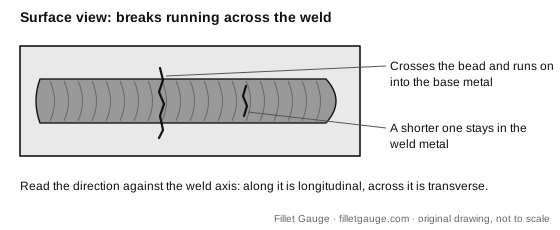
Use this diagram
How to recognize a transverse crack
- Check the direction against the weld axis. Across the bead is transverse. Along it is longitudinal. That single check is the whole naming decision.
- Follow it to its ends. A transverse crack that runs past the toes into the plate is telling you the base metal or heat-affected zone was involved, not just the weld.
- Look for a family. Transverse cracks often come in a series spaced along the weld, especially in hard, high-strength weld metal.
- Don't stop at one pass. In multi-pass welds, transverse cracks can sit in an inner pass and never reach the cap.
Try one question
Question 1 of the free 10-question check on CWI Part B. No signup. Then ask Tack, the AI study buddy, why the answer is right and the others are wrong.
Welding Inspection and Discontinuities
A convex fillet weld replica is checked with a leaf-type fillet gauge. The drawing calls for a single fillet size. The vertical leg fits the 3/8 in blade and the horizontal leg the 5/16 in blade. What size is recorded?
Press A–D or 1–4 to choose an answer while this question is on screen.
Choose an answer to begin
How it is found and recorded
Open surface cracks are visible with good side light and a magnifier. Penetrant testing confirms them on any non-porous metal. Magnetic particle testing finds them in ferromagnetic steel, as long as the magnetic field crosses the crack: a transverse crack needs the field running along the weld, which is the opposite of a longitudinal one. Buried transverse cracks are a challenge for both radiography and ultrasonic testing and often need the technique set up for that orientation. Record location, direction and length, then go to the governing document's crack criteria.
Ask Tack before you buy AI your Fillet Gauge study buddy
See what's on the CWI Part B exam, test yourself with 5 quick questions, or find the plan that fits you.
The CWI Part B course
Available now · instant accessLearn the tool kit, the specification and the qualification records, then practice.
- 7modules of lessonsEvery task on the outline
- 3full-length timed exams46 questions in 120 minutes each
- 338practice questionsEach one explained
- 2worked calculationsStep by step
- 21specification drillsFind it fast in the Book of Specifications
- 1week-by-week study planSet to your exam date
Turn a practice answer into a study step. In untimed practice, ask Tack AI about any question you answer, follow up, then see your weakest topics and what to drill next.
Instant access. Terms and refunds · Secure checkout by Stripe · Billed by Nori Software
- Parts B + C bundle$169$29 less than buying both courses separatelyIncludes the CWI Part B and CWI Part C D1.1 courses
Terms and refunds · Secure checkout by Stripe · Billed by Nori Software
- Full CWI prep$249$48 less than buying the 3 courses separatelyIncludes the CWI Part A, CWI Part B and CWI Part C D1.1 courses
Terms and refunds · Secure checkout by Stripe · Billed by Nori Software
- Free sample lessonFree
- Question of the dayFree
Every answer comes with a full explanation.
Common mix-ups
- Transverse crack or a ripple line. Ripples are curved, regular and shallow. A crack is a single sharp line with pointed ends that cuts through the ripples.
- Transverse crack or a crater crack. Crater cracks are short, often star-shaped and sit in the crater at the end of a bead. A transverse crack can be anywhere along the weld.
- Transverse crack or a grinding mark. Grind lines are straight, parallel and in a group. A crack is single and irregular.
Why it forms
The weld shrinks along its length as it cools, and the plate holds it back. If the weld metal or heat-affected zone is hard, brittle or loaded with hydrogen, it cracks across. Common causes are weld metal much stronger than needed, high restraint, damp consumables, too little preheat for the steel and thickness, and fast cooling.
Transverse cracks on the CWI exam
On Part B, cracks fall under Welding Inspection and Discontinuities, at least 34% of the practical. Field direction for magnetic particle testing belongs to NDE Application. On Part A, transverse cracks tie Visual Examination to Base Materials, Heat Treatments and Metallurgy, where hydrogen and hardness are covered. On Part C, look up the code's crack criteria in your own copy.
Practice it
Name crack directions against their look-alikes in the weld discontinuities quiz. Then read the other direction, longitudinal cracks, and the hydrogen crack that forms out of sight, underbead cracks. Every type is in the weld discontinuities guide.
Check the rest of Part B
Take the free 10-question check. It's weighted to the Part B outline, scored by domain and needs no signup, so you see which domain to study first.
Sources
Show the list
- Defects: Hydrogen Cracks in Steels, Identification (Job Knowledge 45), TWI. Retrieved 25 Oct 2026.
- CWI Part B Practical Examination Information, American Welding Society, Rev. 03.01.2024. Retrieved 20 Oct 2026.
- Discontinuity names follow AWS A3.0, Standard Welding Terms and Definitions. Every description here is our own wording.
Facts checked 25 October 2026 against the sources listed above. If something has changed, tell us and we will correct it within 2 business days.
Your next step
Ready to see where you stand on CWI Part B?
Free, untimed and scored by domain. No signup.
Start the free 10-question checkPart B course. Lessons, timed practice exams and a plan around your exam date. Get Part B course · $99 See the plans or read the free sample lesson.Terms and refunds
Want a timed run? Try the free 25-question mini-mock. The first 5 need no email.
Prefer paper? Free printables
- Print a class quiz (free PDF). 5 practice questions with an answer key on page 2.
- Print the flashcards as cut-out cards (free PDF). The free flashcard sample, ready to cut and carry.
From the blog
- How to choose CWI prep: Parts A, B and C
- CWI Part B replicas and how to practice
- CWI vs CAWI vs SCWI: the three AWS inspector levels