Weld spatter: what it is and how to spot it
Spatter is small droplets of molten metal thrown out of the arc during welding that land and stick on the base metal or the weld beside the joint. The droplets freeze as raised beads, from fine specks to larger blobs. Spatter is a surface condition, not a flaw inside the weld, but it can hide other problems and spoil coatings.
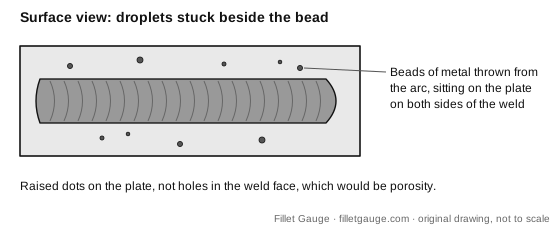
Use this diagram
How to recognize spatter
- Feel or light it from the side. Spatter stands up from the surface. In low-angle light each droplet casts a small shadow on the far side.
- Look either side of the weld. It lands on the plate along both sides of the bead, thickest near the weld and thinning out with distance.
- Check how well it is stuck. Loose spatter flicks off with a chipping hammer or scraper. Spatter that fused hard into the plate leaves a small mark when removed.
- Look at what it covers. Heavy spatter can hide the toe, undercut or a crack under it. Remove it before you judge what is underneath.
Try one question
Question 1 of the free 10-question check on CWI Part B. No signup. Then ask Tack, the AI study buddy, why the answer is right and the others are wrong.
Welding Inspection and Discontinuities
A convex fillet weld replica is checked with a leaf-type fillet gauge. The drawing calls for a single fillet size. The vertical leg fits the 3/8 in blade and the horizontal leg the 5/16 in blade. What size is recorded?
Press A–D or 1–4 to choose an answer while this question is on screen.
Choose an answer to begin
How it is judged
Spatter is found visually. Whether it is acceptable depends on the job: many documents leave it to the contract, the coating system or the engineer, and a part going to be painted or galvanized often needs it removed because coatings won't cover it well. When inspecting, note its extent and whether it blocks your view of the weld. Look up what the governing document or contract says rather than assuming it never matters.
Ask Tack before you buy AI your Fillet Gauge study buddy
See what's on the CWI Part B exam, test yourself with 5 quick questions, or find the plan that fits you.
The CWI Part B course
Available now · instant accessLearn the tool kit, the specification and the qualification records, then practice.
- 7modules of lessonsEvery task on the outline
- 3full-length timed exams46 questions in 120 minutes each
- 338practice questionsEach one explained
- 2worked calculationsStep by step
- 21specification drillsFind it fast in the Book of Specifications
- 1week-by-week study planSet to your exam date
Turn a practice answer into a study step. In untimed practice, ask Tack AI about any question you answer, follow up, then see your weakest topics and what to drill next.
Instant access. Terms and refunds · Secure checkout by Stripe · Billed by Nori Software
- Parts B + C bundle$169$29 less than buying both courses separatelyIncludes the CWI Part B and CWI Part C D1.1 courses
Terms and refunds · Secure checkout by Stripe · Billed by Nori Software
- Full CWI prep$249$48 less than buying the 3 courses separatelyIncludes the CWI Part A, CWI Part B and CWI Part C D1.1 courses
Terms and refunds · Secure checkout by Stripe · Billed by Nori Software
- Free sample lessonFree
- Question of the dayFree
Every answer comes with a full explanation.
Common mix-ups
- Spatter or porosity. Spatter is a raised dot on the surface. Porosity is a hole in the weld metal. One sticks up, the other goes in.
- Spatter or an arc strike. An arc strike is a spot where the base metal melted. Spatter is metal that landed on the plate from the arc.
- Spatter or slag. Slag is the glassy coating from the flux, on top of the bead. Spatter is metal, and it lands beside the weld.
Why it forms
The arc and the transfer of metal across it are unstable. Common causes are too high a current or voltage for the process, a long arc, a steep electrode angle, damp or contaminated consumables, magnetic arc blow, and in GMAW the transfer mode: short-circuit and globular transfer throw more spatter than spray or pulsed transfer. Shielding gas choice matters too, with straight carbon dioxide usually giving more spatter than argon mixes.
Spatter on the CWI exam
On Part A, spatter belongs to Visual Examination and Joining and Cutting Processes, at least 14% of the exam, where transfer modes and parameter effects are covered. On Part B it fits Welding Inspection and Discontinuities, at least 34% of the practical, mainly as a look-alike to separate from porosity and arc strikes on a replica. On Part C, check how your code treats it in the workmanship and visual inspection clauses of your own copy.
Practice it
Separate spatter from porosity and arc strikes in the weld discontinuities quiz. Then read the two it gets confused with: arc strikes and weld porosity. Every type is in the weld discontinuities guide.
Check the rest of Part B
Take the free 10-question check. It's weighted to the Part B outline, scored by domain and needs no signup, so you see whether discontinuities are where your points go.
Sources
Show the list
- CWI Part B Practical Examination Information, American Welding Society, Rev. 03.01.2024. Retrieved 20 Oct 2026.
- CWI Part A Fundamentals Examination Information, American Welding Society, Rev. 03.01.2024. Retrieved 20 Oct 2026.
- Discontinuity names follow AWS A3.0, Standard Welding Terms and Definitions. Every description here is our own wording.
Facts checked 25 October 2026 against the sources listed above. If something has changed, tell us and we will correct it within 2 business days.
Your next step
Ready to see where you stand on CWI Part B?
Free, untimed and scored by domain. No signup.
Start the free 10-question checkPart B course. Lessons, timed practice exams and a plan around your exam date. Get Part B course · $99 See the plans or read the free sample lesson.Terms and refunds
Want a timed run? Try the free 25-question mini-mock. The first 5 need no email.
Prefer paper? Free printables
- Print a class quiz (free PDF). 5 practice questions with an answer key on page 2.
- Print the flashcards as cut-out cards (free PDF). The free flashcard sample, ready to cut and carry.
From the blog
- CWI vs CAWI vs SCWI: the three AWS inspector levels
- CWI Part B practice questions: drill measurements
- CWI Part B replicas and how to practice