Weld underfill: what it is and how to spot it
Underfill is a groove weld whose face, or root surface, sits below the adjacent surface of the base metal. The joint simply wasn't filled with enough weld metal. Unlike undercut, the missing metal is in the weld itself, across the joint, not in the plate at the toe. It reduces the thickness the design relies on.
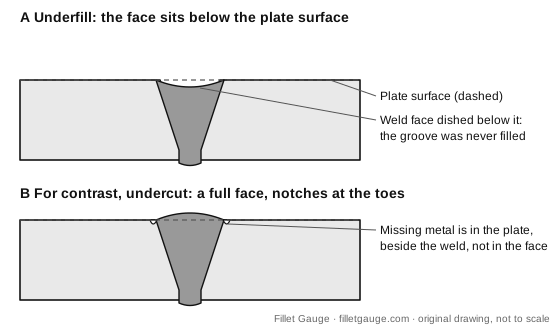
Use this diagram
How to recognize underfill
- Lay a straightedge across the joint. If the weld face sits below a straightedge resting on both plates, the joint is underfilled. On a sound groove weld, the face is at or above the plate.
- Look along the weld. Underfill often comes and goes: low at a stop, a restart or where the welder sped up, then full again.
- Check the back. On a single-sided weld the root surface can be below the back of the plate too. That is often called root concavity or suck-back; read which name your document uses.
- Don't confuse it with design. A partial penetration groove or a flare groove may be designed to sit below flush. Read the welding symbol before calling it underfill.
Try one question
Question 1 of the free 10-question check on CWI Part B. No signup. Then ask Tack, the AI study buddy, why the answer is right and the others are wrong.
Welding Inspection and Discontinuities
A convex fillet weld replica is checked with a leaf-type fillet gauge. The drawing calls for a single fillet size. The vertical leg fits the 3/8 in blade and the horizontal leg the 5/16 in blade. What size is recorded?
Press A–D or 1–4 to choose an answer while this question is on screen.
Choose an answer to begin
How to measure underfill
Measure how far the lowest point of the face sits below the plate surface. A gauge with a depth pointer, zeroed on the plate, or a dial caliper's depth rod resting on the plate both work. Where the members are different thicknesses, measure from the surface of the thinner member, the one the face should reach. Also record where and how long the low area runs. The governing document tells you whether any underfill is allowed and how it is judged.
Ask Tack before you buy AI your Fillet Gauge study buddy
See what's on the CWI Part B exam, test yourself with 5 quick questions, or find the plan that fits you.
The CWI Part B course
Available now · instant accessLearn the tool kit, the specification and the qualification records, then practice.
- 7modules of lessonsEvery task on the outline
- 3full-length timed exams46 questions in 120 minutes each
- 338practice questionsEach one explained
- 2worked calculationsStep by step
- 21specification drillsFind it fast in the Book of Specifications
- 1week-by-week study planSet to your exam date
Turn a practice answer into a study step. In untimed practice, ask Tack AI about any question you answer, follow up, then see your weakest topics and what to drill next.
Instant access. Terms and refunds · Secure checkout by Stripe · Billed by Nori Software
- Parts B + C bundle$169$29 less than buying both courses separatelyIncludes the CWI Part B and CWI Part C D1.1 courses
Terms and refunds · Secure checkout by Stripe · Billed by Nori Software
- Full CWI prep$249$48 less than buying the 3 courses separatelyIncludes the CWI Part A, CWI Part B and CWI Part C D1.1 courses
Terms and refunds · Secure checkout by Stripe · Billed by Nori Software
- Free sample lessonFree
- Question of the dayFree
Every answer comes with a full explanation.
Common mix-ups
- Underfill or undercut. Undercut is a notch melted into the plate at the toe. Underfill is a low weld face. One straightedge settles it: if the face is below it, it is underfill.
- Underfill or an undersize fillet. Fillets are judged by leg and throat size, not by a plate surface across the joint, so a small fillet is undersize, not underfilled.
- Underfill or burn-through. Burn-through melts a hole through the root, often leaving a sunken face above it. Underfill is just not enough metal, with no hole.
Why it forms
Too few passes, or a cap pass that is too small for the groove. Travel speed too fast for the deposit rate. A welder who misjudges the last layer and stops short of flush. On pipe roots, too much heat or the wrong backing gas pressure can pull the root surface up into the joint.
Underfill on the CWI exam
On Part B it fits Welding Inspection and Discontinuities, at least 34% of the practical, where you measure weld profiles on replicas and tell underfill from undercut. On Part A, it belongs to Visual Examination. On Part C, the weld profile and visual acceptance rules are the places to look, D1.1 Clauses 7 and 8 for the D1.1 endorsement.
Practice it
Practice taking depth readings on the weld gauge trainer. Then read the toe look-alike, undercut, and the opposite face condition, excessive reinforcement. The weld discontinuities guide lists every type.
Check the rest of Part B
Take the free 10-question check. It's weighted to the Part B outline, scored by domain and needs no signup, so you see where measuring ranks among your weak spots.
Sources
Show the list
- A general review of geometric shape imperfections, Part 1 (Job Knowledge 67), TWI. Retrieved 25 Oct 2026.
- CWI Part B Practical Examination Information, American Welding Society, Rev. 03.01.2024. Retrieved 20 Oct 2026.
- Discontinuity names follow AWS A3.0, Standard Welding Terms and Definitions. Every description here is our own wording.
Facts checked 25 October 2026 against the sources listed above. If something has changed, tell us and we will correct it within 2 business days.
Your next step
Ready to see where you stand on CWI Part B?
Free, untimed and scored by domain. No signup.
Start the free 10-question checkPart B course. Lessons, timed practice exams and a plan around your exam date. Get Part B course · $99 See the plans or read the free sample lesson.Terms and refunds
Want a timed run? Try the free 25-question mini-mock. The first 5 need no email.
Prefer paper? Free printables
- Print a class quiz (free PDF). 5 practice questions with an answer key on page 2.
- Print the flashcards as cut-out cards (free PDF). The free flashcard sample, ready to cut and carry.
From the blog
- Visual weld inspection: before, during and after
- CWI Part B practice questions: drill measurements
- CWI vs CAWI vs SCWI: the three AWS inspector levels