Lamination in steel plate: what it is and how to spot it
A lamination is a flat separation inside rolled metal, running parallel to the surface, usually near the middle of the plate's thickness. It is a base metal discontinuity that comes from the steel mill, not from welding: impurities or voids in the original ingot or slab get flattened into thin planes as the steel is rolled.
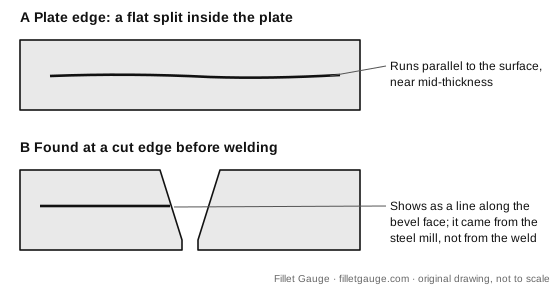
Use this diagram
How to recognize a lamination
- Look at cut edges. A lamination that reaches a sheared, sawn or thermally cut edge shows as a thin line along the edge, parallel to the plate surfaces, often near mid-thickness.
- Look at bevels before welding. Preparing a groove exposes a fresh edge. A line along the bevel face is a warning sign, because welding over it can open it up.
- Don't expect to see it from the face. A lamination fully inside the plate gives no sign on the rolled surface. Plate that sounds or rings oddly, or a bulge after heating, are rare clues.
- Think plate, not weld. If the flaw lies in the plate, runs with the rolling direction and isn't tied to the weld bead, it is likely a lamination.
Try one question
Question 1 of the free 10-question check on CWI Part B. No signup. Then ask Tack, the AI study buddy, why the answer is right and the others are wrong.
Welding Inspection and Discontinuities
A convex fillet weld replica is checked with a leaf-type fillet gauge. The drawing calls for a single fillet size. The vertical leg fits the 3/8 in blade and the horizontal leg the 5/16 in blade. What size is recorded?
Press A–D or 1–4 to choose an answer while this question is on screen.
Choose an answer to begin
How it is found and recorded
Straight-beam ultrasonic testing is the standard method. A lamination lies parallel to the surface, so sound sent straight into the plate bounces off it early, before it reaches the back wall. Radiography is poor at finding laminations, because on plate the beam crosses the thin plane at right angles, so the gap adds almost nothing to the thickness it travels through and the film shows little contrast. At edges, visual inspection and penetrant or magnetic particle testing work. Record location, length and depth. Many documents set rules for laminations found at cut edges or bevel faces, so read the one that governs the job.
Ask Tack before you buy AI your Fillet Gauge study buddy
See what's on the CWI Part B exam, test yourself with 5 quick questions, or find the plan that fits you.
The CWI Part B course
Available now · instant accessLearn the tool kit, the specification and the qualification records, then practice.
- 7modules of lessonsEvery task on the outline
- 3full-length timed exams46 questions in 120 minutes each
- 338practice questionsEach one explained
- 2worked calculationsStep by step
- 21specification drillsFind it fast in the Book of Specifications
- 1week-by-week study planSet to your exam date
Turn a practice answer into a study step. In untimed practice, ask Tack AI about any question you answer, follow up, then see your weakest topics and what to drill next.
Instant access. Terms and refunds · Secure checkout by Stripe · Billed by Nori Software
- Parts B + C bundle$169$29 less than buying both courses separatelyIncludes the CWI Part B and CWI Part C D1.1 courses
Terms and refunds · Secure checkout by Stripe · Billed by Nori Software
- Full CWI prep$249$48 less than buying the 3 courses separatelyIncludes the CWI Part A, CWI Part B and CWI Part C D1.1 courses
Terms and refunds · Secure checkout by Stripe · Billed by Nori Software
- Free sample lessonFree
- Question of the dayFree
Every answer comes with a full explanation.
Common mix-ups
- Lamination or lamellar tearing. A lamination is already in the plate when it arrives. Lamellar tearing is a crack that forms during or after welding, in steps, because weld shrinkage pulled on a plate with weak through-thickness ductility.
- Lamination or incomplete fusion. Incomplete fusion is an unbonded line at the boundary between weld and base metal. A lamination is entirely inside the base metal, often well away from the weld.
- Lamination or a scab or seam. Seams and scabs are rolling flaws on the surface. A lamination is internal.
Why it matters for welding
A lamination is a plane of weakness. Welding near or across one can open it, let it carry a crack into the joint, or trap gas that comes out as porosity at the bevel. It also blocks ultrasonic testing of the weld beyond it. That is why some jobs call for ultrasonic scanning of plate near tee and corner joints before fabrication starts.
Laminations on the CWI exam
On Part A, laminations fit Base Materials, Heat Treatments and Metallurgy and NDE Fundamentals, where you match a flaw's orientation to the method that sees it. On Part B they fit Welding Inspection and Discontinuities and NDE Application. On Part C, look up how your code treats discontinuities at cut edges in your own copy.
Practice it
Drill which NDE method sees a flat, plate-parallel flaw in the NDE methods quiz. Then read its welding-made cousin, lamellar tearing, and the other crack that hides beside a weld, underbead cracks. The weld discontinuities guide lists every type.
Check the rest of Part B
Take the free 10-question check. It's weighted to the Part B outline, scored by domain and needs no signup, so you see where NDE and materials stand against your other domains.
Sources
Show the list
- Defects: Lamellar Tearing (Job Knowledge 47), TWI. Retrieved 25 Oct 2026.
- CWI Part A Fundamentals Examination Information, American Welding Society, Rev. 03.01.2024. Retrieved 20 Oct 2026.
- Discontinuity names follow AWS A3.0, Standard Welding Terms and Definitions. Every description here is our own wording.
Facts checked 25 October 2026 against the sources listed above. If something has changed, tell us and we will correct it within 2 business days.
Your next step
Ready to see where you stand on CWI Part B?
Free, untimed and scored by domain. No signup.
Start the free 10-question checkPart B course. Lessons, timed practice exams and a plan around your exam date. Get Part B course · $99 See the plans or read the free sample lesson.Terms and refunds
Want a timed run? Try the free 25-question mini-mock. The first 5 need no email.
Prefer paper? Free printables
- Print a class quiz (free PDF). 5 practice questions with an answer key on page 2.
- Print the flashcards as cut-out cards (free PDF). The free flashcard sample, ready to cut and carry.
From the blog
- CWI Part B replicas and how to practice
- CWI Part B practice questions: drill measurements
- CWI vs CAWI vs SCWI: the three AWS inspector levels