Weld undercut: what it is and how to spot it
Undercut is a groove melted into the base metal at the toe of a weld and left unfilled by weld metal. It runs along the edge of a fillet or groove weld, or along the root of a single-sided groove weld, and it thins the base metal exactly where the weld shape already concentrates stress.
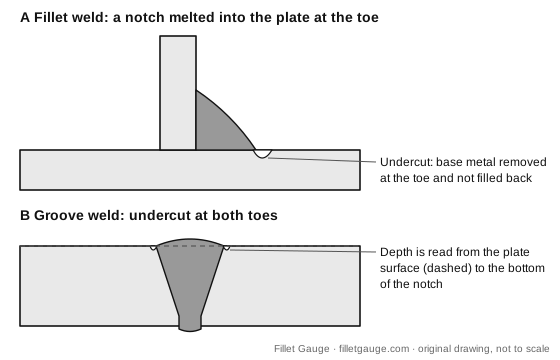
Use this diagram
How to recognize undercut
- Go to the toe. Undercut is always at the boundary between weld and base metal. Run your eye, and a low-angle flashlight, along each toe.
- Look for a shadow line. A sharp, continuous or intermittent shadow along the toe, with base metal visibly missing, is the usual look. A finger or fingernail drawn across the toe catches on it.
- Decide which side the metal left. If the hollow is in the plate beside the weld, it is undercut. If the weld face itself is low, it is underfill.
- Check the root too. On a weld made from one side, the back of the joint can be undercut along the root toes.
Try one question
Question 1 of the free 10-question check on CWI Part B. No signup. Then ask Tack, the AI study buddy, why the answer is right and the others are wrong.
Welding Inspection and Discontinuities
A V-WAC undercut pointer reads 0.004 in when set on flat base metal and cannot be rezeroed. Along a toe it then reads 0.012, 0.019, 0.027 and 0.015 in. Use this example rule, not the book's value: undercut up to 0.025 in deep is acceptable. What is the correct decision?
Press A–D or 1–4 to choose an answer while this question is on screen.
Choose an answer to begin
How to measure undercut
Depth is the number that matters. Set an undercut gauge, such as the pointer on a V-WAC gauge, on flat base metal next to the toe and zero it there, or note the reading if it can't be zeroed. Then slide it to the deepest part of the notch and read the depth from the original plate surface. A dial caliper's depth rod does the same job. Also record length, since many documents limit undercut by depth and accumulated length together, and the limit may change with the loading of the joint. Look that limit up in the governing document; don't carry a number in your head.
Ask Tack before you buy AI your Fillet Gauge study buddy
See what's on the CWI Part B exam, test yourself with 5 quick questions, or find the plan that fits you.
The CWI Part B course
Available now · instant accessLearn the tool kit, the specification and the qualification records, then practice.
- 7modules of lessonsEvery task on the outline
- 3full-length timed exams46 questions in 120 minutes each
- 338practice questionsEach one explained
- 2worked calculationsStep by step
- 21specification drillsFind it fast in the Book of Specifications
- 1week-by-week study planSet to your exam date
Turn a practice answer into a study step. In untimed practice, ask Tack AI about any question you answer, follow up, then see your weakest topics and what to drill next.
Instant access. Terms and refunds · Secure checkout by Stripe · Billed by Nori Software
- Parts B + C bundle$169$29 less than buying both courses separatelyIncludes the CWI Part B and CWI Part C D1.1 courses
Terms and refunds · Secure checkout by Stripe · Billed by Nori Software
- Full CWI prep$249$48 less than buying the 3 courses separatelyIncludes the CWI Part A, CWI Part B and CWI Part C D1.1 courses
Terms and refunds · Secure checkout by Stripe · Billed by Nori Software
- Free sample lessonFree
- Question of the dayFree
Every answer comes with a full explanation.
Common mix-ups
- Undercut or underfill. Undercut takes metal out of the plate at the toe. Underfill leaves the weld face below the plate surface. Same tool, different location.
- Undercut or overlap. Overlap adds unfused weld metal on top of the plate at the toe. Undercut removes plate metal.
- Undercut or a toe crack. A crack is a sharp, tight line with no visible width to its floor. Undercut has a rounded, open hollow you can measure.
Why it forms
Too much heat at the edge of the pool melts the plate faster than filler can replace it. The usual causes are excessive current, a long arc, too fast a travel speed, a poor electrode angle pointed at the plate, and on a weave, not pausing at each side. Fillet welds in the horizontal position are especially prone along the upper toe, where gravity pulls the pool down.
Undercut on the CWI exam
Undercut is a measuring task, so it is central to Part B: Welding Inspection and Discontinuities is at least 34% of the practical, and reading depth correctly on a replica is a core skill there. On Part A, it fits Visual Examination and Welding Application and Control. On Part C you look up the visual acceptance criteria for undercut in your code, D1.1 Clause 8 for the D1.1 endorsement, and read the conditions on loading in your own copy.
Practice it
Practice reading undercut depth on the weld gauge trainer. Then compare it with the two toe and face look-alikes: underfill and overlap. The weld discontinuities guide has every type in one table.
Check the rest of Part B
Take the free 10-question check. It's weighted to the Part B outline, scored by domain and needs no signup, so you see whether measuring or another domain is costing you points.
Sources
Show the list
- A general review of geometric shape imperfections, Part 1 (Job Knowledge 67), TWI. Retrieved 25 Oct 2026.
- CWI Part B Practical Examination Information, American Welding Society, Rev. 03.01.2024. Retrieved 20 Oct 2026.
- Discontinuity names follow AWS A3.0, Standard Welding Terms and Definitions. Every description here is our own wording.
Facts checked 25 October 2026 against the sources listed above. If something has changed, tell us and we will correct it within 2 business days.
Your next step
Ready to see where you stand on CWI Part B?
Free, untimed and scored by domain. No signup.
Start the free 10-question checkPart B course. Lessons, timed practice exams and a plan around your exam date. Get Part B course · $99 See the plans or read the free sample lesson.Terms and refunds
Want a timed run? Try the free 25-question mini-mock. The first 5 need no email.
Prefer paper? Free printables
- Print a class quiz (free PDF). 5 practice questions with an answer key on page 2.
- Print the flashcards as cut-out cards (free PDF). The free flashcard sample, ready to cut and carry.
From the blog
- How to choose CWI prep: Parts A, B and C
- CWI Part B practice questions: drill measurements
- CWI vs CAWI vs SCWI: the three AWS inspector levels