Arc strike: what it is and how to spot it
An arc strike is a small spot of melted, resolidified metal on the base metal outside the weld, left where an arc was struck or touched by accident. It can come from the electrode, the electrode holder or a poor ground clamp. The spot cools very fast, so it can be hard, brittle and cracked even though it looks minor.
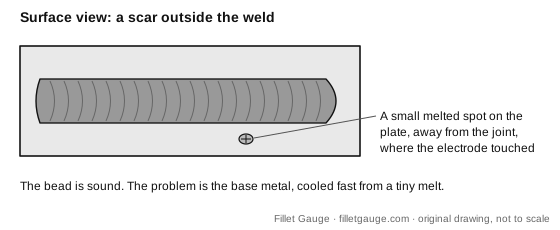
Use this diagram
How to recognize an arc strike
- Look off the weld. Arc strikes sit on the base metal, outside the joint. Check the plate either side of the weld, around the ground clamp and anywhere the welder might have rested or struck the electrode.
- Look for a small melted spot. It is usually a small, round or irregular scar, sometimes with a tiny crater, a bit of slag or a discolored ring around it.
- Look for little lines in it. Because the spot quenches so fast, it can have fine cracks. A magnifier and side light help.
- Check where the ground was. A loose or arcing ground clamp leaves burn marks too, and they count as arc strikes.
Try one question
Question 1 of the free 10-question check on CWI Part B. No signup. Then ask Tack, the AI study buddy, why the answer is right and the others are wrong.
Welding Inspection and Discontinuities
A convex fillet weld replica is checked with a leaf-type fillet gauge. The drawing calls for a single fillet size. The vertical leg fits the 3/8 in blade and the horizontal leg the 5/16 in blade. What size is recorded?
Press A–D or 1–4 to choose an answer while this question is on screen.
Choose an answer to begin
How it is found and recorded
Visual inspection finds arc strikes. When one is found, the next question is whether it is cracked, so a surface method, magnetic particle or penetrant testing, often follows, especially after it has been ground. Record the location. On some work the repair is to grind the strike out and check the area, and some documents call for a hardness check or a surface method afterward. Look up what the governing document requires rather than assuming a light grind is enough.
Ask Tack before you buy AI your Fillet Gauge study buddy
See what's on the CWI Part B exam, test yourself with 5 quick questions, or find the plan that fits you.
The CWI Part B course
Available now · instant accessLearn the tool kit, the specification and the qualification records, then practice.
- 7modules of lessonsEvery task on the outline
- 3full-length timed exams46 questions in 120 minutes each
- 338practice questionsEach one explained
- 2worked calculationsStep by step
- 21specification drillsFind it fast in the Book of Specifications
- 1week-by-week study planSet to your exam date
Turn a practice answer into a study step. In untimed practice, ask Tack AI about any question you answer, follow up, then see your weakest topics and what to drill next.
Instant access. Terms and refunds · Secure checkout by Stripe · Billed by Nori Software
- Parts B + C bundle$169$29 less than buying both courses separatelyIncludes the CWI Part B and CWI Part C D1.1 courses
Terms and refunds · Secure checkout by Stripe · Billed by Nori Software
- Full CWI prep$249$48 less than buying the 3 courses separatelyIncludes the CWI Part A, CWI Part B and CWI Part C D1.1 courses
Terms and refunds · Secure checkout by Stripe · Billed by Nori Software
- Free sample lessonFree
- Question of the dayFree
Every answer comes with a full explanation.
Common mix-ups
- Arc strike or spatter. Spatter is a droplet of metal stuck on top of the plate. An arc strike is a spot where the plate itself melted.
- Arc strike or surface porosity. Porosity is a hole in the weld metal. An arc strike is on the base metal, outside the weld.
- Arc strike or a crater. A crater is at the end of a weld bead. An arc strike is away from the bead altogether.
Why it matters
The arc melts a tiny pool on cold, thick plate that pulls the heat away almost instantly. On many steels that creates a hard, brittle spot with no preheat to soften it, and often a small crack. In service, especially under fatigue or impact loading, that spot can start a crack in an otherwise sound member. Good practice is simple: strike the arc in the joint or on a run-on tab, keep holders insulated and secure the ground clamp.
Arc strikes on the CWI exam
On Part A, arc strikes fit Visual Examination and Welding Application and Control, where the welder's practice is covered. On Part B they fit Welding Inspection and Discontinuities, at least 34% of the practical. On Part C for the D1.1 endorsement, look under the Clause 7 workmanship rules, not only the Clause 8 visual acceptance criteria: a weld can pass Clause 8 and still break the Clause 7 arc strike rule, so read your own copy.
Practice it
Separate arc strikes from spatter and porosity in the weld discontinuities quiz. Then read the droplet look-alike, spatter, and the other quick-quench crack site, crater cracks. All types are in the weld discontinuities guide.
Check the rest of Part B
Take the free 10-question check. It's weighted to the Part B outline, scored by domain and needs no signup, so you see where your Part B points are slipping.
Sources
Show the list
- CWI Part B Practical Examination Information, American Welding Society, Rev. 03.01.2024. Retrieved 20 Oct 2026.
- CWI Part A Fundamentals Examination Information, American Welding Society, Rev. 03.01.2024. Retrieved 20 Oct 2026.
- Discontinuity names follow AWS A3.0, Standard Welding Terms and Definitions. Every description here is our own wording.
Facts checked 25 October 2026 against the sources listed above. If something has changed, tell us and we will correct it within 2 business days.
Your next step
Ready to see where you stand on CWI Part B?
Free, untimed and scored by domain. No signup.
Start the free 10-question checkPart B course. Lessons, timed practice exams and a plan around your exam date. Get Part B course · $99 See the plans or read the free sample lesson.Terms and refunds
Want a timed run? Try the free 25-question mini-mock. The first 5 need no email.
Prefer paper? Free printables
- Print a class quiz (free PDF). 5 practice questions with an answer key on page 2.
- Print the flashcards as cut-out cards (free PDF). The free flashcard sample, ready to cut and carry.
From the blog
- CWI Part B replicas and how to practice
- How to choose CWI prep: Parts A, B and C
- Visual weld inspection: before, during and after